

How to Fix Sleep Schedule: how to fix sleep schedule in 3 simple steps
If you've ever tried to force an early bedtime only to lie awake staring at the ceiling, you weren't failing a test of willpower. You were fighting your own biology.
Trying to fix your sleep schedule really comes down to one core idea: anchoring your wake-up time. This one move, when you pair it with smart morning light exposure and a solid evening routine, sends the most powerful signals your body needs to reset its internal clock.
The Real Reason It's So Hard to Fix Your Sleep
The root of a broken sleep schedule is almost always a misaligned circadian rhythm. Think of this as your body's internal 24-hour master clock. It's the system that tells you when to feel alert and when to feel sleepy.
When your internal clock gets out of sync with the actual day-night cycle, everything feels off. Your energy tanks, your focus vanishes, and your mood can take a serious hit. This isn't just about being tired; it's a state of biological confusion.
Common Culprits That Wreck Your Internal Clock
Getting your rhythm back on track starts with figuring out what threw it off in the first place. For most of us, the problem isn't some mystery illness—it's a handful of common, and often overlooked, daily habits.
-
Social Jetlag: This is probably the biggest offender. You stick to a tight schedule from Monday to Friday, only to stay up late and sleep in all weekend. This weekly whiplash is like flying to a new time zone every Friday and flying back Sunday night. It constantly destabilizes your internal clock, which is why Monday mornings feel so brutal.
-
Late-Night Screen Time: The blue light blasting from your phone, tablet, and TV is a powerful signal to your brain that it's still daytime. It directly suppresses the production of melatonin, the hormone that tells your body it’s time to sleep. Scrolling through Instagram for an hour before bed is essentially shouting at your brain, "Stay awake!"
-
Erratic Meal Times: It's not just your brain that has a clock; your digestive system does, too. Eating a huge meal late at night forces your body to focus on digestion when it should be powering down for rest. Keeping your meal times consistent, especially your first and last meals of the day, helps reinforce your body's overall timing.
"A misaligned circadian rhythm is like having a watch that's always a few hours off. You can still tell time, but you'll constantly be late for some things and early for others, leaving you perpetually out of sync with your environment."
Why "Just Go to Bed Earlier" Fails
The classic advice to just hit the sack earlier rarely works because your body simply isn't ready. Your internal clock is still running on its old, later schedule. This means your melatonin levels haven't risen and your core body temperature hasn't dropped—two key biological triggers you need to fall asleep.
Trying to force it only leads to frustration and anxiety, which makes sleep even harder to come by. The real solution isn't about brute force. It’s about methodically retraining your internal clock with consistent, predictable cues every single day.
Once you identify your specific disruptors—whether it's weekend sleep-ins or late-night snacking—you can start making targeted changes. This is how you turn that vague, tired frustration into a clear action plan.
Your Action Plan for a Full Circadian Reset
Knowing what’s wrecking your sleep is one thing; building a blueprint to fix it is another. Resetting your sleep schedule isn't about finding a single magic bullet. It’s about sending consistent, powerful signals to your brain that pull your internal clock back into alignment.
This plan is built on four core pillars: anchoring your wake-up time, using light strategically, creating a practical wind-down ritual, and being mindful of your nutrition. These pieces work together to send unmistakable "day" and "night" cues to your body. You'll soon see why a consistent wake-up time is actually far more powerful than a consistent bedtime for this process.
Anchor Your Wake-Up Time
If you only do one thing, do this: wake up at the same time every single day. Yes, that means weekends. And holidays. Even when you feel exhausted. This non-negotiable wake-up time is the primary anchor for your entire circadian rhythm.
When your wake-up time is predictable, your body learns to anticipate it. It starts releasing cortisol at the right moment to promote alertness and, just as importantly, sets a timer for when to release melatonin that evening. Hitting snooze all week and then sleeping in until noon on Saturday creates "social jetlag," a frustrating state that leaves your internal clock confused and your body in a perpetual fog.
Common habits like social jetlag, late-night screen use, and erratic meals all send conflicting signals that throw your natural rhythm out of whack.
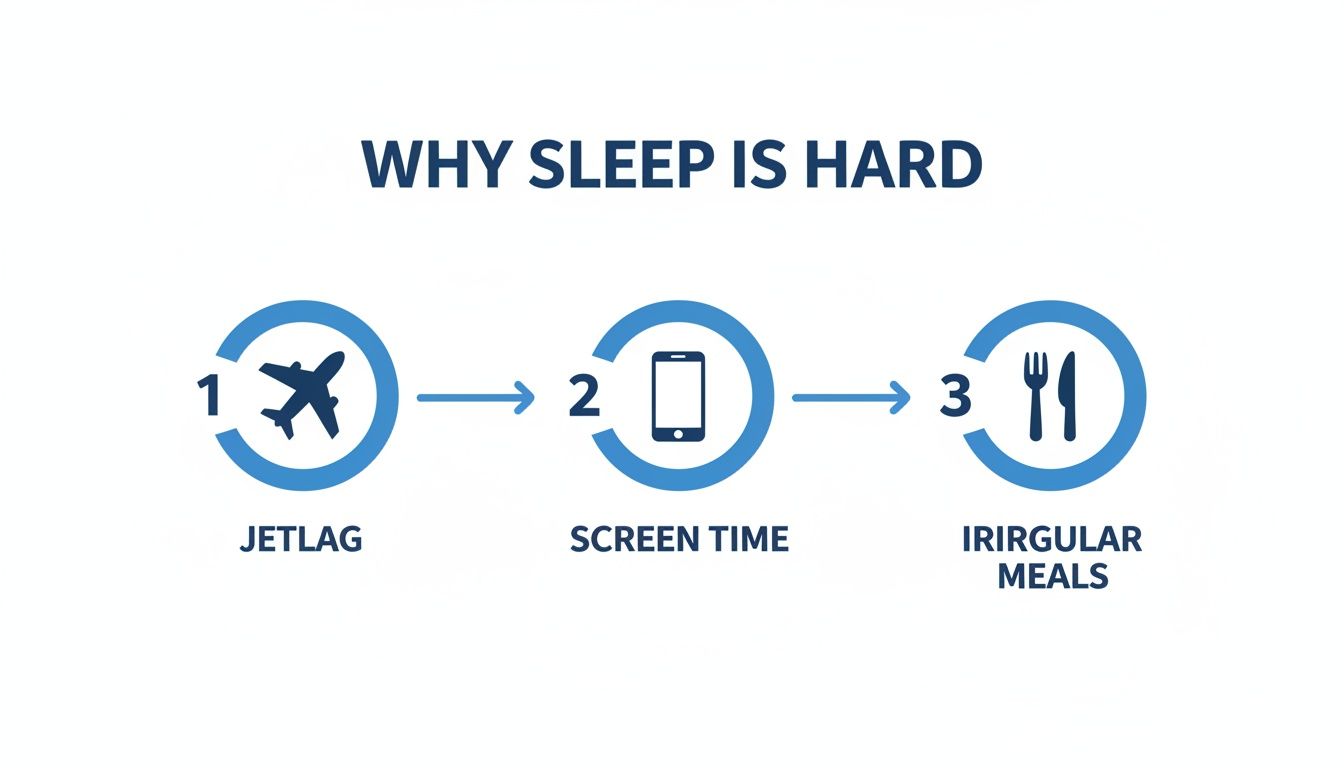
Each of these habits tells your brain a different story, making it impossible to establish the predictable sleep-wake pattern you need.
Use Light Strategically
Light is the most powerful environmental cue for your internal clock. Your entire strategy should hinge on two key moments: getting bright light in the morning and avoiding it at night.
-
Morning Light: Within 30 minutes of waking, get your eyes in front of bright, natural sunlight for at least 15-20 minutes. Leave the sunglasses off. This is a powerful signal that tells your brain to shut down melatonin production and start the clock for the day. This simple habit also has a big impact on vitamin D levels, and you can learn more by unlocking the health benefits of Vitamin D3 supplementation.
-
Evening Darkness: In the 60-90 minutes before you want to be asleep, dim the lights in your home. It's crucial to avoid the blue light from screens (phones, TVs, tablets), as studies show it can suppress melatonin by over 23%. If you absolutely must use a screen, switch it to night mode or throw on a pair of blue-light-blocking glasses.
The consistency of your sleep timing can be incredibly impactful. Global sleep studies have shown that a regular schedule can slash your insomnia risk by up to 40%. Yet, so many people struggle with this fundamental principle.
Research highlights a major disconnect: on average, people lose almost three full nights of restorative sleep every week. A surprising 22% of individuals simply accept poor sleep as their reality, and 45% don't track their sleep to even see the problematic patterns. Fixing this starts with that non-negotiable wake-up time. It anchors everything.
Create a Wind-Down Ritual and Mind Your Nutrition
Your brain can't just flip a switch from "on" to "off." It needs a transition period to shift from the alertness of the day to the calm of the night. A simple, repeatable wind-down routine signals this change. This isn't complicated—it could be reading a physical book, taking a warm bath (the drop in body temperature afterward promotes sleep), or doing some light stretching.
Finally, think about what and when you eat. Steer clear of large, heavy meals and caffeine within a few hours of bed. A big meal forces your digestive system to work overtime right when it should be resting, while caffeine can linger in your system for hours, making it harder to fall and stay asleep.
How to Master Your Morning to Win the Day
The secret to fixing your sleep schedule isn’t found in the moments before you go to bed; it’s forged in the first hour after you wake up. Your morning routine is the most powerful lever you can pull to reset your internal clock, and it all starts with one key ingredient: light.
Your brain's master clock, the suprachiasmatic nucleus, is incredibly sensitive to light. When bright light hits your eyes in the morning, it sends an immediate, powerful signal to your brain to stop producing melatonin, the hormone of darkness. This action effectively starts the countdown timer for your entire day, influencing when you’ll naturally feel sleepy again that night.

Harness the Power of Morning Light
The goal is simple: get 15–20 minutes of direct, natural sunlight within the first 30–60 minutes of waking up. This doesn't mean you need a perfectly clear, sunny day. Even the ambient light on a cloudy morning is potent enough to send the right signals.
Step outside, leave your sunglasses behind, and let the light do its work. This isn’t just about feeling more awake in the moment—this single habit can significantly shift your entire circadian rhythm forward, making it much easier to fall asleep at your desired bedtime later.
It's a surprisingly powerful intervention. Exposure to morning light within 30 minutes of waking can realign your schedule in just 3–5 days for 70% of people, cutting daytime fatigue by 35%. This light naturally boosts serotonin and cortisol, signaling 'daytime' to your brain's master clock and advancing your evening melatonin onset by 1–2 hours. You can learn more about these powerful sleep initiative trends.
What If Sunlight Isn't an Option?
For many of us, getting natural morning light just isn't practical. You might live in a climate with long, dark winters, or maybe your workday begins long before the sun rises. In these cases, a light therapy box is an incredibly effective substitute.
Look for a lamp that provides 10,000 lux of brightness. Position it about 12–16 inches from your face for 15–30 minutes while you have your coffee or check emails. This artificial light mimics the full-spectrum brightness of the sun and sends the exact same "wake-up" signal to your brain.
Fuel Your Body to Stabilize Energy
What you eat for your first meal of the day plays a huge supporting role in anchoring your schedule. A breakfast heavy in refined carbs and sugar can cause a rapid spike and subsequent crash in blood sugar, leading to that dreaded mid-morning slump and energy instability all day.
Instead, prioritize protein. A protein-forward breakfast helps stabilize blood sugar and provides a steady release of energy. This metabolic stability reinforces the "active and alert" signals you sent with morning light.
Examples of a Protein-Forward Breakfast:
- Scrambled eggs with spinach and avocado
- Greek yogurt with berries and a handful of nuts
- A protein smoothie with whey or a plant-based powder
This simple dietary shift does more than just fuel your muscles; it helps regulate your energy and mood, which are critical components of a well-functioning daily rhythm. Building these kinds of supportive habits is fundamental, and you can explore more ways to support your well-being.
Add Light Movement to Your Morning
Finally, incorporating just a few minutes of light physical activity can amplify your morning's success. This doesn't need to be an intense workout. The goal is simply to get your blood flowing and raise your core body temperature slightly.
A brisk walk (which you can combine with your sunlight exposure), some gentle stretching, or a few bodyweight squats will do the trick. This movement further reinforces your body’s “it’s time to be active” message, working in concert with light and food to lock in your wake-up time.
By mastering these first 60 minutes, you set the stage for better energy all day and an easier time falling asleep at night.
Crafting a Wind-Down Routine You'll Actually Do
Your brain doesn't have an 'off' switch. After a day packed with tasks, decisions, and constant stimulation, it needs a clear, gentle transition from the chaos of 'doing' to the calm of 'resting.' This is where a wind-down routine becomes one of the most powerful tools for fixing your sleep schedule.
This isn't about adding more chores to your evening. It’s about creating a simple, repeatable ritual that signals to your body and mind that the day is over and it's safe to power down. The goal is to find a sequence of actions that you find genuinely relaxing and can stick with night after night.

Implement a Digital Sunset
Let's be blunt: the single most disruptive element in modern sleep is the glowing screen. The blue light blasting from our phones, tablets, and TVs actively suppresses melatonin, the very hormone that tells your body it’s time for bed. To fight back, the first and most critical step is to create a "digital sunset."
This means putting away all screens 60–90 minutes before your target bedtime. This isn't just a suggestion; it's a non-negotiable rule for a serious sleep reset. I recommend charging your phone across the room—if it's on your nightstand, the temptation to "just check one thing" is too strong.
This buffer period allows your brain's natural melatonin production to finally kick in, initiating the physiological processes that lead to sleep. Think of this time as a protected sanctuary for your mind to decompress without any artificial light interference.
Lower Your Core Body Temperature
One of the key biological triggers for sleepiness is a slight drop in your core body temperature. You can strategically use this to your advantage. A surprisingly effective way to do this is by taking a warm bath or shower about 90 minutes before bed.
While you're in the warm water, your body's temperature rises. But when you get out, the rapid cooling effect sends a powerful signal to your brain that it's time to get drowsy. This simple act mimics a natural part of the sleep-initiation process and can make it significantly easier to feel ready for bed.
Don't have time for a full bath? Even just soaking your feet in warm water can produce a similar, albeit milder, effect.
Offload Your Mental Chatter
Lying in bed with racing thoughts is one of the biggest barriers to falling asleep quickly. Your wind-down routine should include a way to get these thoughts out of your head and onto paper.
Journaling for just five or ten minutes can be incredibly effective. Don't worry about writing perfectly; the goal here is to perform a "brain dump."
Try These Journaling Prompts:
- The To-Do List: Write down everything you need to do tomorrow. Once it's on paper, your brain is more likely to let go of it for the night.
- The Worry Dump: List anything that's causing you anxiety or stress. Simply acknowledging these worries can strip them of their power.
- The Gratitude List: Jot down three good things, no matter how small, that happened during the day. This helps shift your focus to positive thoughts before sleep.
A consistent, relaxing bedtime routine isn't just a nice-to-have; it's a biological necessity. By creating predictable cues—like dimming the lights, reading, or journaling—you help condition your body to anticipate sleep, making the transition smoother and more efficient.
Replace Screens with Calming Activities
So, what are you supposed to do during this new screen-free hour? The key is to choose something calm and enjoyable that doesn't involve bright lights or intense mental effort. The goal is relaxation, not productivity.
- Read a Physical Book: Reading on a backlit device can still disrupt sleep, but a real book under a dim, warm lamp is a fantastic way to unwind.
- Listen to Calming Audio: Put on a podcast, an audiobook, or some quiet, ambient music. This can help distract your mind from racing thoughts and fill the silence.
- Practice Gentle Stretching or Meditation: Simple stretches can release the physical tension you've held onto all day. A guided meditation app (listened to, not watched) can also do wonders for calming the nervous system.
Finding the right combination of activities that works for you is the final piece of the puzzle. This personalized ritual, performed consistently, becomes a powerful cue that tells your entire system it’s time to rest, recover, and recharge.
Using Supplements and Tools the Smart Way
While lifestyle changes are the undisputed foundation of a healthy sleep schedule, the right supplements and tools can be powerful allies. Think of them not as a quick fix, but as strategic support for the hard work you're already doing.
The goal here isn't to find a sedative that just knocks you out. That's not real sleep. A smart approach means choosing tools that help your body’s natural processes work better, supporting your circadian rhythm instead of overriding it.
Magnesium Glycinate for a Calmer Nervous System
Magnesium is a workhorse mineral, involved in over 300 different processes in the body, including many that help regulate your nervous system and encourage relaxation. The problem is, many of us don't get enough, which can show up as restlessness or that "wired but tired" feeling at night.
Magnesium glycinate is a specific, highly absorbable form that’s also gentle on the stomach. It works by interacting with GABA receptors, which are essentially the "off" switches in your brain. This helps quiet down mental chatter and physical tension, making it easier to unwind. You can learn more in our complete guide to magnesium glycinate for sleep.
This isn't a sleeping pill. It simply creates a state of calm that allows your natural sleep drive to take the wheel. It's a fantastic addition to your evening wind-down, especially on high-stress days.
Melatonin for Short-Term Resets Only
Melatonin is probably the most famous sleep supplement, but it's also the most misused. It’s a hormone your own body makes when it gets dark, acting as a signal that sleep is approaching. As a supplement, it should only be used for specific, short-term situations.
Think of it as a tool to manually nudge your internal clock. It’s incredibly useful for things like:
- Jet Lag: Helping your body sync up to a new time zone.
- Initial Circadian Shifts: Aiding a gradual shift to an earlier bedtime right when you start your reset.
The secret is using a very low dose—just 0.5 to 3 milligrams—taken about 90 minutes before your new target bedtime. Relying on high doses or taking it every single night can backfire, making your body less sensitive to its own natural melatonin. It's a temporary aid, not a long-term solution.
Bright Light Therapy for a Powerful Morning Cue
Just as darkness tells your body it's time to sleep, bright light in the morning is the most powerful signal to wake up and get going. If you wake up before the sun or live in a gloomy climate, a light therapy box can be a game-changer.
These devices are designed to mimic the intensity and spectrum of natural sunlight. Sitting in front of a 10,000-lux light therapy box for 15–30 minutes right after you wake up sends a clear message to your brain: stop producing melatonin, and kickstart alertness.
This powerful morning cue helps lock in your wake-up time, which is critical for regulating when you’ll feel tired later that evening. This isn't just for seasonal affective disorder; it's a core tool for anyone serious about resetting their body clock. By using these tools intelligently, you give targeted support to your lifestyle changes, making your journey to a stable sleep schedule much faster and more sustainable.
Troubleshooting Your Sleep Reset: Your Questions Answered
Starting a journey to reclaim your sleep schedule is a powerful move, but let's be real—it almost always brings up a few practical questions. As you put these new habits into practice, you’re bound to hit some real-world sticking points. This section is all about tackling those common hurdles with clear, actionable advice to keep you on track.
How Long Does It Really Take to Fix a Sleep Schedule?
This is the big one, and the honest answer is: it depends on your consistency. While you'll probably start feeling a difference within a few days, give it a solid 1 to 2 weeks of dedicated effort for your circadian rhythm to truly lock in. You're essentially re-training your body's internal clock, and that takes a little patience.
If your schedule has been seriously out of sync for months (or years), it might take closer to a month to feel fully reset. The most important thing to remember is that consistency beats perfection. One late night won't derail everything. Just acknowledge it and get right back to your routine the next day.
Your wake-up time is the most powerful anchor for your internal clock. Even if you go to bed late, get up at your target time the next morning. It’ll feel tough for a day, but it’s the fastest way to get your rhythm back on track.
Can I Still Sleep In on Weekends?
Ah, the weekend lie-in. This is probably the single biggest trap for most people, and it even has a name: social jetlag.
It’s so tempting to "catch up" on sleep, but sleeping in for more than 60–90 minutes on Saturday and Sunday can undo a week's worth of hard work. It sends confusing signals to your brain, making that Monday morning alarm feel just as brutal as before.
If you’re genuinely wiped out by the time the weekend rolls around, a short, strategic nap is a much better option.
A Smarter Way to Nap:
- Keep it short. Aim for just 20–30 minutes. That's the sweet spot for restoring alertness without making you feel groggy (sleep inertia) or messing with your nighttime sleep.
- Time it right. The ideal nap window is in the early afternoon, usually between 1 p.m. and 3 p.m. Napping any later than that can make it harder to fall asleep when your real bedtime comes around.
Once your new schedule feels completely second nature, a little extra sleep on a Saturday morning won't be a huge deal. But while you're in the reset phase, it's best to avoid it altogether.
What Should I Do If I Wake Up in the Middle of the Night?
First off, don't panic. Waking up briefly is a totally normal part of the human sleep cycle. The real trouble starts when you get anxious about being awake, which kicks off a stress response that makes falling back asleep even harder.
The number one rule? Don't look at the clock. Clock-watching inevitably leads to stressful mental math ("Oh great, I only have three hours left to sleep!"), which just fuels your anxiety.
If you can't drift back off within about 20 minutes, the best thing you can do is get out of bed.
Go to another room with dim, warm lighting and do something completely boring until you feel sleepy again.
- Read a few pages of a physical book (no screens!).
- Listen to some quiet, ambient music or a boring podcast.
- Do a few minutes of gentle, meditative breathing.
This tactic helps break the frustrating mental link between your bed and being awake. Only head back to bed when you feel that wave of drowsiness return.
Is It Better to Change My Bedtime Gradually or All at Once?
For nearly everyone, a gradual shift is the way to go. It's far more successful and much less painful.
Trying to force yourself to go to bed three hours earlier overnight is a recipe for frustration. You'll just end up lying there wide awake, staring at the ceiling, because your internal clock is still running on the old schedule. A much gentler and more effective approach is to nudge your schedule in small increments.
The Gradual Shift Method:
- Start by moving your target bedtime and wake-up time earlier by just 15 to 30 minutes.
- Stick with this new schedule for two or three days until it starts to feel normal.
- Once you've adjusted, shift your schedule again by another 15 to 30 minutes.
- Repeat this cycle until you've landed on your ideal sleep and wake times.
This slow-and-steady method gives your internal clock time to adjust without causing massive daytime fatigue or sleep-related stress. It’s the most reliable way to make the change stick for good.
At Elemental Edge Health, we believe that foundational wellness starts with restorative sleep. Our clean, research-backed supplements are designed to support your body's natural rhythms, helping you achieve the energy and vitality you deserve. Explore our collection to find the perfect support for your wellness journey at https://www.elementaledgehealth.com.
About the Author
Kim Brissett-Lier is the founder of Elemental Edge Health. After losing 100+ lbs in his 40s and rebuilding his strength, energy, and mental clarity through targeted supplementation and consistent daily habits, Kim created Elemental Edge to help other adults 40+ experience the same transformation — without the extremes. He writes about magnesium, creatine, Vitamin D, sleep, stress resilience, and the fundamentals of long-term health and performance.