

Magnesium Glycinate for Sleep: How It Works, Dosage & When to Take It
If you're a high-performer juggling a demanding career or an intense training schedule, a restless night isn't just frustrating—it's a performance killer.
This guide tackles that problem head-on. We're going to reframe magnesium glycinate for sleep not as just another supplement, but as a strategic tool for unlocking deep recovery, mental clarity, and next-day vitality.
Your Search For Better Sleep Ends Here
Looking for a complete overview? See our full guide: Everything You Should Know About Magnesium Glycinate: Benefits, Dosage, and Quality →
Related: If nighttime charlie horses are what wake you, read magnesium glycinate for leg cramps for the mechanism, the evidence, and realistic expectations.
For so many driven people, bedtime becomes a battleground. You lie awake, your mind racing through tomorrow's to-do list while your body stays stubbornly tense. It's a vicious cycle that sabotages everything from cognitive function and mood to physical recovery and immune health.
This guide goes way beyond generic sleep advice. We're diving into why one specific nutrient—magnesium glycinate—is a superior solution for calming both a racing mind and a tense body.
By the end of this guide, you won't just know that magnesium glycinate can improve your sleep. You'll understand why it works and how to use it effectively to reclaim your nights and supercharge your days.
If you're choosing a magnesium glycinate: ours is 275 mg elemental magnesium, 90 capsules, third-party tested and manufactured in the USA, $29.99 with free U.S. shipping. See the label and lab report → · Customer reviews on Trustpilot
How Magnesium Glycinate Calms Your Brain
Magnesium is the conductor who steps in to quiet the chaos of an overactive nervous system. It works on a sophisticated biochemical level to prep your mind for deep, restorative rest.
That same calming action supports daytime focus, not just sleep. Our complete guide to cognitive function breaks down how magnesium, creatine, and vitamin D3 support brain energy and clarity.
Taming Your Brain's Accelerator
A racing mind at night is often caused by an excitatory neurotransmitter called glutamate. Magnesium acts as the natural brake. It parks itself on the same cellular receptors that glutamate tries to activate (specifically, the NMDA receptors). By blocking these spots, magnesium stops glutamate from overstimulating your brain.
Boosting Your Brain's Calming Agent
While blocking the brain's accelerator, magnesium also hits the brake pedal by boosting your primary calming neurotransmitter: GABA. If glutamate is the gas, GABA is the brake, slowing down brain activity and promoting relaxation. The "glycinate" part comes from glycine, an amino acid that's bound to the magnesium and is a calming neurotransmitter on its own.
This synergy is key. Magnesium quiets the noise, while glycine deepens the calm, creating the perfect internal environment to finally drift off to sleep.
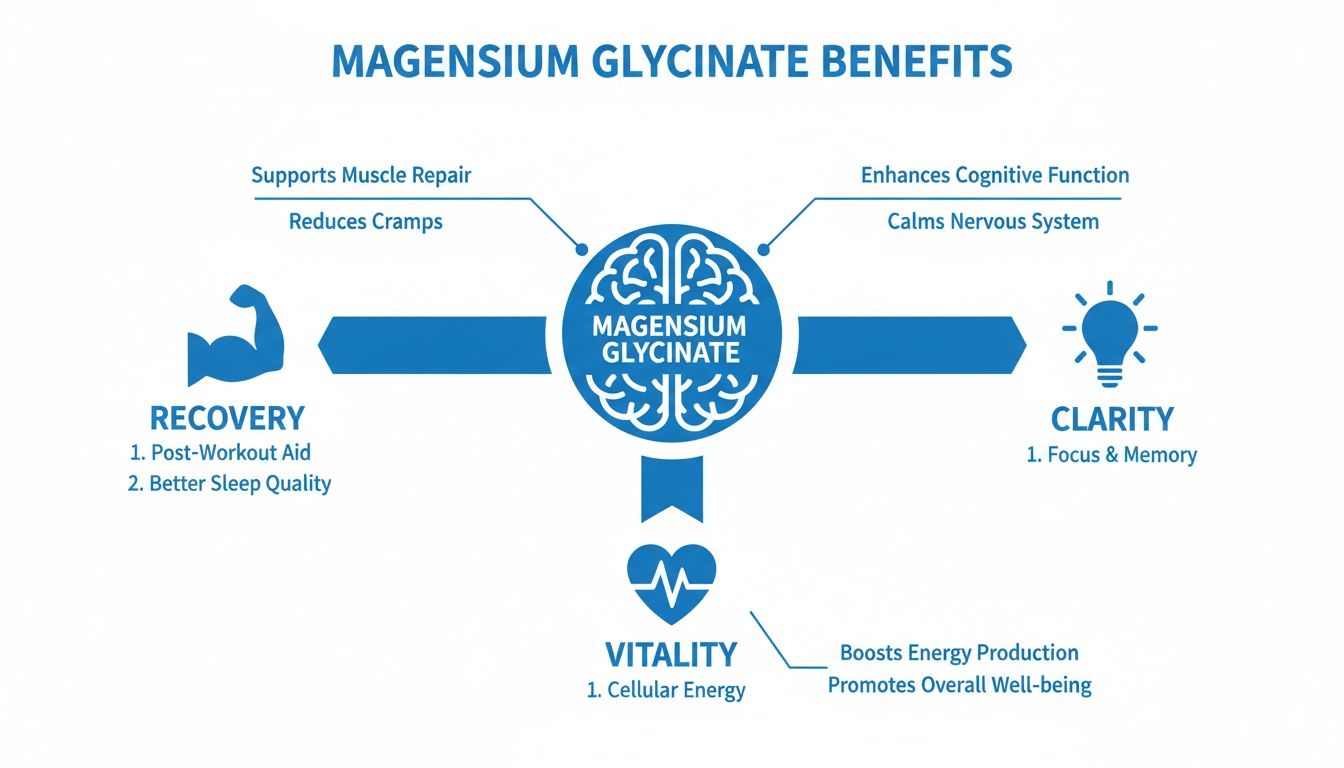
Magnesium's role in sleep is inseparable from its role in circadian function. It is required for the enzymatic conversion of serotonin to melatonin — the hormone that signals your body clock it's time to sleep. If your sleep issues run deeper than just falling asleep, it's worth understanding how the body's master clock works. Read our step-by-step guide on how to reset your circadian rhythm for a full breakdown of what disrupts the clock after 40 and how to fix it.
Regulating Your Sleep-Wake Cycle
Beyond juggling neurotransmitters, magnesium is also a key player in regulating melatonin, the hormone that runs your internal sleep clock. Your body simply can't produce enough melatonin without adequate magnesium. At the same time, magnesium helps manage levels of the stress hormone cortisol. A 20-year study following young American adults found a clear link between higher magnesium consumption and better sleep quality over the long haul.
Sleep disruption driven by shifting magnesium needs isn't limited to aging or stress — it's also one of the most common complaints during pregnancy, particularly in the second and third trimesters. If that's what brought you here, see our dedicated guide on magnesium during pregnancy for trimester-specific dosing and safety guidance.
Lowering Body Temperature for Sleep
Glycine has been shown to increase blood flow to the skin, which allows heat to escape more easily. This gentle cool-down effect can help you fall asleep faster and get into deeper, more restorative stages of sleep.
Deep Sleep and Neurological Repair
Deep sleep is the sleep stage most affected by aging after 40 — adults in their 40s and 50s get up to 30% less slow-wave sleep than they did in their 20s. If you're waking unrestored despite sleeping 7–8 hours, disrupted sleep architecture is likely the cause. For a complete science-backed protocol on restoring your sleep cycle, including the 4-pillar framework and a week-by-week timeline, read our guide on how to restore your sleep cycle after 40.
Deep sleep is when your body releases growth hormone, repairs muscle tissue, clears metabolic waste from the brain, and resets stress hormones. REM sleep supports memory consolidation, emotional regulation, and cognitive performance.
According to research published in Sleep (Oxford Academic), magnesium supplementation may improve sleep efficiency and total sleep time in certain populations.
Choosing The Right Magnesium For Your Sleep Goals

The secret to unlocking magnesium's power comes down to two simple but critical ideas: bioavailability and chelation.
Why Not All Magnesium Is Created Equal
Bioavailability is how much of a nutrient your body can actually absorb and use. Chelation is where the magnesium mineral is chemically bonded to another molecule, usually an amino acid, making it far easier for your body to absorb. With magnesium glycinate, the magnesium is chelated to glycine — the gold standard for sleep and relaxation.
The Glycinate Advantage For Sleep And Recovery
Because magnesium glycinate is so well-absorbed, it gets to your nervous system and muscles to deliver its calming benefits without the gut drama common with cheaper forms like oxide or citrate.
Ready to experience the glycinate advantage for yourself?
Elemental Edge Magnesium Glycinate is fully chelated, gentle on digestion, and formulated specifically for adults who want deeper sleep, faster muscle recovery, and genuine calm.
Manufactured in the USA • Third-Party Tested • Free U.S. Shipping • 30-Day Money-Back Guarantee
Comparing Popular Magnesium Forms
| Magnesium Form | Primary Use | Bioavailability | Digestive Impact |
|---|---|---|---|
| Magnesium Glycinate | Sleep, relaxation, anxiety relief, muscle recovery | Excellent | Very gentle, minimal laxative effect |
| Magnesium Citrate | Constipation relief, general supplementation | Good | Can have a strong laxative effect |
| Magnesium Oxide | Constipation, heartburn, indigestion | Poor | Very strong laxative effect |
| Magnesium Threonate | Cognitive function, brain health | Good | Generally gentle on the stomach |
What The Research Says About Magnesium And Sleep
A randomized controlled trial found that adults taking 250 mg of elemental magnesium combined with glycine saw a statistically significant improvement in sleep quality over four weeks, with an average reduction of 3.9 points on the Insomnia Severity Index scale.
Magnesium Glycinate Dosage for Sleep

Start with 200 mg of elemental magnesium taken 30 to 60 minutes before you want to be asleep. For a full breakdown of how much to take and when, see our magnesium glycinate dosage guide.
Creating A Powerful Sleep Synergy
Consider pairing magnesium glycinate with L-Theanine (100-200mg before bed), a mindful evening ritual, and a warm bath before sleep. Worth knowing before you add anything: L-theanine's evidence is strongest for daytime focus rather than for stress or sleep itself — we cover what each of the common calming supplements actually does, and at what dose, in our guide to the best supplements for stress relief. Start building the foundation of your new nightly routine with Elemental Edge Health Magnesium Glycinate.
Beyond Sleep: The Full-Body Benefits Of Magnesium
Magnesium is a key player in over 300 biochemical reactions in your body. Learn more about the full benefits of supplementing with magnesium glycinate.
Common Questions, Answered
How Long Does It Take for Magnesium Glycinate to Work?
Many people feel the calming effects within 30-60 minutes. The deeper benefits build over one to two weeks of consistent nightly use.
Is It Safe to Take Every Night?
Yes, for most healthy adults, when sticking to recommended dosages (typically under 350 mg of elemental magnesium from supplements). Check with your doctor before starting any new supplement.
What's the Difference Between Glycinate and Bisglycinate?
They are essentially the same thing — one magnesium ion bound to two glycine molecules. The same stable, fully chelated form that makes it so absorbable and gentle.
Are There Any Side Effects or Interactions to Worry About?
Magnesium glycinate very rarely causes digestive issues. It can affect absorption of certain antibiotics and osteoporosis medications. If you take prescription drugs for heart conditions or kidney disease, talk with your doctor first.
See why it works and how to take it →
→ Try Magnesium Glycinate risk-free — 30-Day Money-Back Guarantee
Complete Your Daily Foundation
For adults over 40, the most effective daily stack combines creatine for strength and cognitive support, magnesium glycinate for recovery and sleep, and vitamin D3 for immune and bone health. Get all three together with the Essential Edge Stack — one daily habit, full foundation covered.
Related: magnesium's calming action is also a cornerstone of cortisol control — see our guide to the best supplements for cortisol and stress management over 40.
Once you know glycinate is the form for sleep, the next question is how it compares to every other option on the shelf. Our 2026 buyer's guide to the best magnesium for sleep and muscle recovery over 40 ranks glycinate, citrate, oxide, and L-threonate by absorption, GI tolerance, and price per effective dose.
About the Author
Kim Brissett-Lier is the founder of Elemental Edge Health. After losing 100+ lbs in his 40s and rebuilding his strength, energy, and mental clarity through targeted supplementation and consistent daily habits, Kim created Elemental Edge to help other adults 40+ experience the same transformation — without the extremes. He writes about magnesium, creatine, Vitamin D, sleep, stress resilience, and the fundamentals of long-term health and performance.