

The Best Supplements for Stress Relief and a Calmer Mind
When you go looking for something to take the edge off, three options come up again and again: magnesium glycinate, ashwagandha, and L-theanine. They are not interchangeable. They work on different systems, the evidence behind them is not equally strong, and one of them carries a safety signal most articles leave out entirely.
This guide sorts out which one matches the kind of stress you actually have — and, just as importantly, tells you where the research is thinner than the marketing suggests.
The Short Answer
If stress shows up in your body — tight shoulders, a clenched jaw, restless nights — magnesium glycinate is the place to start, and it has the most consistent evidence for that job. If stress shows up as a chronically over-revved system and you feel worn down, ashwagandha has the strongest data for lowering cortisol, but it should not be taken by anyone who is pregnant, has a thyroid or autoimmune condition, or has liver disease. If you need to stay sharp under pressure during the day, L-theanine at 200 mg helps attention more reliably than it helps stress. No supplement outperforms fixing sleep — and magnesium is the one that most directly supports it.
How Chronic Stress Actually Wears You Down
Short bursts of stress are useful. Your hypothalamic-pituitary-adrenal (HPA) axis releases cortisol, you get focus and energy, and the system stands down afterward. The problem is what happens when it never stands down.
When cortisol stays elevated for months, the downstream effects compound: sleep gets shallower, recovery from training slows, appetite and cravings shift, and the mental fog that used to show up occasionally becomes the default. For adults past 40, this lands harder, because the baseline capacity to buffer it is already declining. We cover that age-specific angle in depth in our guide to cortisol and stress management after 40.
There is also a nutrient cost. Sustained stress increases urinary magnesium excretion, and low magnesium status appears to make stress responses feel worse — a loop that is easier to interrupt than to ignore. If you want the background on why so many people run low in the first place, we walk through it in magnesium and modern life.
Magnesium Glycinate: The Foundation, Not the Fix

Magnesium is a cofactor in more than 300 enzyme systems, including many that govern nerve signalling, muscle relaxation and energy production. It is not exotic. It is infrastructure.
And a lot of people are running short. According to the NIH Office of Dietary Supplements, an estimated 48% of Americans consume less magnesium from food and beverages than the Estimated Average Requirement. That is a shortfall in intake — not the same thing as clinical deficiency, which is uncommon in otherwise healthy people because the kidneys tighten up excretion to compensate. Worth being precise about: you will see "half of Americans are deficient" repeated all over the internet, and it overstates what the data actually show.
What the Evidence Supports — and What It Doesn't
Here is the honest version, because this is where most stress-supplement content quietly inflates.
A 2017 systematic review of 18 intervention studies found results suggestive of a benefit for subjective anxiety in anxiety-prone groups — but the authors rated the overall quality of the evidence as poor, citing inconsistent placebo controls and strong placebo responses. A 2024 systematic review of 15 trials reached a similar conclusion: likely helpful for mild anxiety and insomnia, particularly in people with low baseline magnesium, with small samples and mixed designs.
The best single recent trial is a 2025 randomized, double-blind, placebo-controlled study of 155 adults taking 250 mg of elemental magnesium bisglycinate daily. It found a statistically significant improvement in insomnia severity at four weeks — but a small one, and the benefit was clearest in people whose dietary magnesium was already low.
The realistic expectation: magnesium is most likely to help if you are not getting enough of it. It is a foundation you restore, not a sedative you take. Anyone promising dramatic overnight anxiety relief from a mineral is selling you something.
Why the Glycinate Form — Carefully Stated
Magnesium glycinate is magnesium chelated to the amino acid glycine. The usual claim is that this makes it dramatically better absorbed than other forms. The evidence is thinner than that claim implies, and we would rather tell you so.
The one direct head-to-head study is small, old, and in an unusual population: 12 patients with ileal resections. Overall absorption was comparable to magnesium oxide; glycinate was better absorbed only in the subset with the most impaired absorption. What the authors did report across the whole group was that the chelate was better tolerated.
That tolerability point is the real argument, and it is a good one. Magnesium oxide is among the forms most commonly associated with a laxative effect — which is exactly why a lot of people conclude "magnesium doesn't work for me" when what actually happened is they took a form their gut disliked. If you want the full comparison, see our breakdown of glycinate versus citrate versus oxide.
One more note, because it gets misrepresented constantly: glycine on its own has been studied for sleep, with about 3 grams before bed improving subjective sleep quality in small trials. A magnesium glycinate capsule delivers a fraction of that. The glycine is a reasonable mechanistic bonus — it is not the reason the product works, and we are not going to pretend otherwise.
Practical dosing: most adults supplement in the range of 200–400 mg of elemental magnesium daily, taken in the evening. Note that the Tolerable Upper Intake Level for supplemental magnesium is 350 mg/day for adults. Our full dosing guidance is in the magnesium glycinate dosage guide, and the sleep-specific detail is in magnesium glycinate for sleep.
Magnesium Glycinate — 275 mg Elemental, Properly Dosed
275 mg of elemental magnesium per serving in the chelated glycinate form — no proprietary blends, no artificial colors or flavors, third-party tested with a certificate of analysis published for the batch. 90 capsules, a full 30-day supply.
Shop Magnesium Glycinate →Ashwagandha: The Strongest Cortisol Data — and a Warning You Need to Read
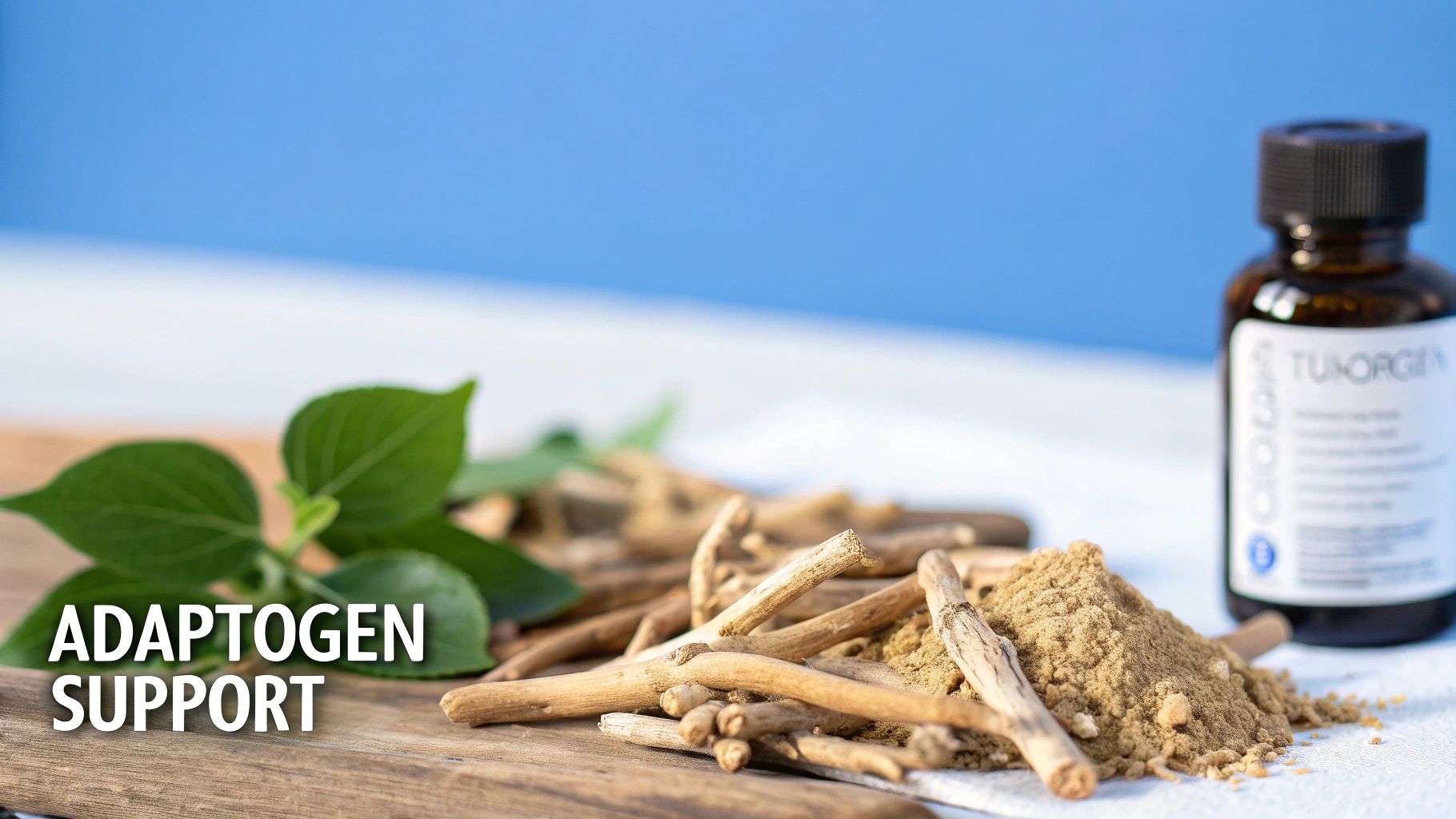
Ashwagandha (Withania somnifera) is an adaptogen — the working idea being that it helps modulate the stress response rather than sedating it. Of the three supplements here, it has the most direct evidence for actually lowering cortisol.
Several randomized, double-blind, placebo-controlled trials support it. A 2012 trial in 64 adults taking 300 mg of a high-concentration root extract twice daily for 60 days found significant reductions across all stress scales and in serum cortisol. A 2019 trial in 60 adults tested 250 mg and 600 mg daily and found reductions in perceived stress and cortisol at both doses, with a clearer effect at the higher one. A systematic review of 52 trials of plants acting on the HPA axis found that a morning cortisol-lowering effect from ashwagandha was the single most consistent finding in that entire literature.
Caveats worth knowing: these trials are small (around 60 participants each), short (8–10 weeks), single-centre, and several were funded by or run with extract manufacturers. The direction of effect is consistent; the certainty is not as high as the marketing implies.
Safety: Read This Before Taking Ashwagandha
The NIH's LiverTox database classifies ashwagandha as a likely cause of clinically apparent liver injury, with roughly two dozen reported cases since 2017 and an increasing trend. Onset is typically two to twelve weeks after starting. Most cases resolve within one to four months of stopping, but rare cases of liver failure requiring transplant have occurred, particularly in people with existing liver disease.
Per NCCIH, ashwagandha should be avoided in pregnancy and is not recommended while breastfeeding, before surgery, or for people with thyroid disorders, autoimmune conditions, liver disease, or hormone-sensitive prostate cancer. It may interact with thyroid medication, sedatives, immunosuppressants, antihypertensives and diabetes medication. Long-term safety beyond about three months is not well established. Talk to your doctor first — this one genuinely warrants it.
To be straightforward about our own position: Elemental Edge does not sell ashwagandha. We are including it because the evidence is real and you deserve the full picture — along with the safety information that a company selling it has less incentive to put in front of you.
L-Theanine: Better for Focus Than for Stress
L-theanine is the amino acid in green tea associated with "alert calm." The popular claim is that it reduces anxiety. The current evidence supports something narrower and more specific.
A 2026 systematic review and meta-analysis of 31 randomized trials covering 1,168 participants found that a single 200 mg dose taken 30–60 minutes beforehand meaningfully improved choice reaction time — a marker of attention. Effects on acute stress were modest and driven largely by studies at high risk of bias, and effects on anxiety were inconsistent and did not reach significance.
Two trials worth knowing about, because they get cited selectively: a 28-day randomized trial at 400 mg daily found no significant difference in salivary cortisol against placebo, and the placebo group's improvement in perceived stress essentially matched theanine's. A 2024 trial in 80 participants found 200 mg did not shift salivary stress markers during an acute stress challenge.
The fair summary: L-theanine is a good tool for staying composed and focused under pressure, and it takes the jittery edge off caffeine. It is not an anxiolytic, and the stress-hormone story is weaker than the label copy suggests. If cognitive performance under load is your actual goal, our guide to enhancing cognitive function covers the wider picture. We do not sell L-theanine either.
Which One Matches Your Stress?
| Magnesium Glycinate | Ashwagandha | L-Theanine | |
|---|---|---|---|
| Best for | Physical tension, poor sleep, muscle tightness | Feeling chronically over-revved and worn down | Staying sharp and composed under acute pressure |
| Typical dose | 200–400 mg elemental, evening (UL for supplements: 350 mg) | 250–600 mg root extract daily | 200 mg, 30–60 min before you need it |
| Strength of evidence | Modest but consistent; strongest if intake is low | Most direct cortisol data; small, short trials | Good for attention; weak/null for stress |
| Time to notice | 1–3 weeks for sleep and tension | 4–8 weeks | Within an hour, acute |
| Key caution | Excess supplemental magnesium can loosen stools | Liver injury signal; avoid in pregnancy, thyroid, autoimmune, liver disease | Few safety concerns reported |
| Daily foundation or as-needed? | Daily foundation | Time-limited course | As needed |
How to Judge Supplement Quality Without a Chemistry Degree
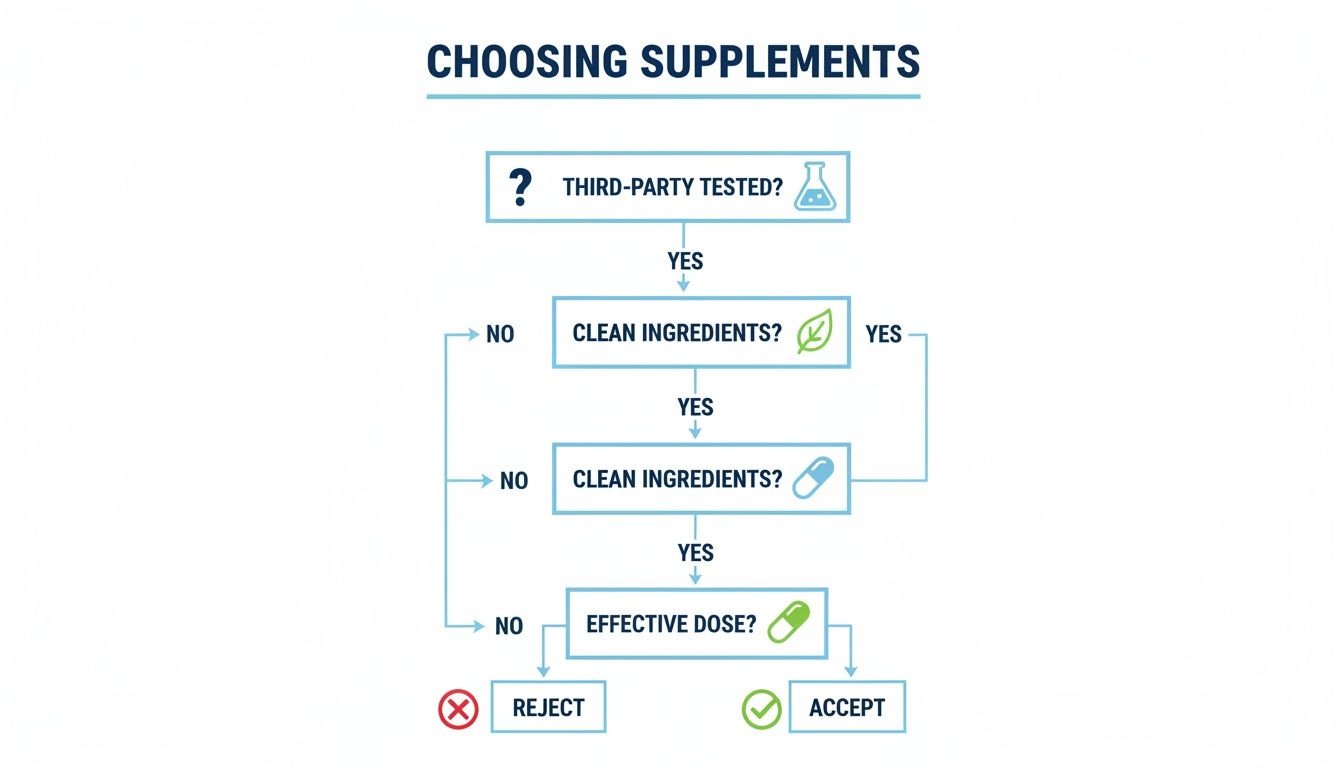
The supplement aisle rewards confident marketing over verifiable quality. Three things actually separate a good product from an expensive one.
1. Dose transparency beats ingredient count
The clearest red flag is a proprietary blend — several ingredients grouped under one trademarked name with a single combined weight, so you cannot tell how much of anything you are getting. It exists to hide underdosing. A formula that lists each ingredient with its own amount is telling you something a blend deliberately will not.
Match that dose against what was actually studied. Ashwagandha trials used 250–600 mg of root extract; a product delivering 50 mg inside a blend is not going to reproduce that. Same principle for elemental magnesium — and note "elemental" specifically, because 2,500 mg of magnesium glycinate is not 2,500 mg of magnesium.
2. Understand what "third-party tested" does and does not mean
This distinction matters, and most brands blur it deliberately, so here it is plainly.
Third-party batch testing means a brand pays an independent laboratory to analyse its batches and, if it is being transparent, publishes the resulting certificates of analysis. That is real analytical data from outside the company. But the brand chooses which batches get tested and which results get published. There is no facility audit and no standing body that can revoke anything.
Formal certification — NSF Certified for Sport, USP Verified, Informed Sport — is a different tier. These programs test lot by lot, review formulation and labelling, conduct unannounced facility inspections, and monitor on an ongoing basis. NSF Certified for Sport screens for roughly 290 substances banned in competitive sport.
Where we stand, since it would be hypocritical not to say: Elemental Edge publishes a certificate of analysis for each batch from an independent laboratory — you can read ours here. We are not NSF or USP certified. Those programs add facility audits and continuous oversight beyond batch testing. If you compete in a tested sport, buy something carrying an NSF Certified for Sport or Informed Sport mark, from us or anyone else.
3. Ignore the filler panic
A lot of supplement content tells you to avoid magnesium stearate and silicon dioxide. That advice is not supported by the evidence, and it is worth correcting because it sends people toward worse products for no reason.
Both are manufacturing aids used in tiny quantities — a flow agent and an anti-caking agent. The European Food Safety Authority formally re-evaluated magnesium salts of fatty acids in 2018 and found them of no safety concern at the levels used, and re-assessed silicon dioxide in 2024 with the same conclusion. The magnesium stearate scare traces back to a 1990 study on isolated mouse immune cells — not humans, and at exposures unrelated to what is in a capsule.
Spend your scrutiny on dose and testing. That is where the real differences live.
Building a Stress Protocol That Actually Holds
The most common mistake is treating supplements as the intervention. They are the smallest lever in the system. Here is the order that works.
- Fix sleep first. Nothing on this page competes with consistent, adequate sleep for regulating cortisol. If your sleep is broken, start there — our sleep cycle restoration protocol is the practical version.
- Restore the foundation before adding anything exotic. Magnesium in the evening, daily, for at least three to four weeks before judging it. Consistency matters far more than the specific hour you take it.
- Add vitamin D if your status is low. Magnesium is required to activate vitamin D, so the two work better together than either alone — we cover the mechanism in D3 and magnesium synergy. Low vitamin D status is associated with depressive symptoms, though the evidence there concerns mood rather than stress specifically.
- Only then consider an adaptogen, as a time-limited course, after reading the safety section above and speaking with your doctor.
- Give it 90 days before you draw conclusions. The compounding benefits of magnesium and D3 show up over weeks to months, not days. The single biggest reason people conclude "supplements don't work" is that they stopped at week two, or ran out and never reordered.
The 90-Day Foundation Protocol
Step 5 is the one people skip. The 90-Day Foundation ships as a complete seven-bottle quarter — three Magnesium Glycinate, three Creatine Monohydrate and a full 90-day supply of Vitamin D3 — so you set the habit once and let it compound through the window where the benefits actually appear. Free U.S. shipping.
Explore the 90-Day Foundation →Frequently Asked Questions
How quickly will I feel the effects?
It depends entirely on which one. L-theanine is acute — within about an hour. Magnesium's effects on sleep and physical tension typically build over one to three weeks, and the trials measuring it ran four weeks or longer. Ashwagandha trials ran 8–10 weeks. If something promises same-day transformation from a mineral or a root extract, treat that as a marketing claim rather than a clinical one.
Can I take magnesium, ashwagandha and L-theanine together?
There is no known direct interaction between the three, and they act on different pathways. But that is not the same as recommending it. Stacking three things at once means that if something works — or if you react badly — you will have no idea which one did it. Start with magnesium alone, give it three to four weeks, then decide whether you still need anything else. And given the interaction profile above, do not add ashwagandha without clearing it with your doctor first.
Is magnesium glycinate better than other forms for stress?
For most people it is the sensible default, mainly on tolerability rather than proven superior absorption. NIH ODS lists aspartate, citrate, lactate and chloride among the better-absorbed forms — glycinate is not on that list, though it is not contradicted either. What glycinate reliably offers is a chelated form that is gentle on digestion, which matters because the most common reason people abandon magnesium is the laxative effect of cheaper forms.
Should I take magnesium in the morning or at night?
Evening, for stress and sleep purposes. It fits the wind-down and there is no benefit to splitting it across the day for this goal. The far more important variable is taking it every day rather than most days.
Can supplements replace therapy or medication for anxiety?
No. Everything on this page addresses the physiological substrate of ordinary life stress. Clinical anxiety and depression are medical conditions with effective evidence-based treatments, and a mineral is not a substitute for either. If stress has moved past manageable — if it is affecting your work, relationships, or ability to function — talk to a doctor or a mental health professional. That is the right tool for that job.
What if magnesium upsets my stomach?
Reduce the dose and take it with food. If you were taking magnesium oxide, switching to a chelated form usually resolves it, since oxide is the form most associated with a laxative effect. Persistent digestive upset at a normal dose is worth mentioning to your doctor.
*These statements have not been evaluated by the Food and Drug Administration. This product is not intended to diagnose, treat, cure, or prevent any disease. This article is for informational purposes only and is not medical advice. Talk with your healthcare provider before starting any supplement, particularly if you are pregnant or breastfeeding, take prescription medication, or have a diagnosed medical condition.
About the Author
Kim Brissett-Lier is the founder of Elemental Edge Health. At age 51, after losing over 100 pounds, Kim built Elemental Edge to engineer clinical-grade, transparent longevity nutrition protocols designed specifically for active adults over 40. Read more about Elemental Edge Health.