

How to Improve Sleep Quality for Truly Restorative Rest
Improving your sleep quality is all about learning to work with your body's natural rhythms, not against them. By creating a reliable sleep schedule, managing your light exposure, and adopting simple rituals before bed, you can signal to your brain that it's time for deep, restorative rest.
If you're researching magnesium glycinate benefits, you're likely looking for a form that absorbs efficiently and supports relaxation without digestive discomfort. Elemental Edge Magnesium Glycinate is a fully chelated form designed for superior bioavailability and gentle nighttime support.
Why Quality Sleep Is Your Ultimate Performance Enhancer

Quality sleep isn't just about feeling less tired; it's the single most powerful performance-enhancing tool you have. During deep sleep, your system gets to work repairing muscle, consolidating memories, and flushing out the metabolic junk that builds up in the brain while you're awake.
The Real Cost of Sleep Debt
When you don't get enough quality sleep, you rack up a "sleep debt" with real-world consequences. Recent data shows that people lose nearly three nights of restorative sleep each week on average, and almost one in four people accept their poor sleep instead of trying to fix it. You can read the full survey findings on sleep struggles.
The biggest mindset shift is to stop seeing sleep as a passive state of doing nothing. It's an active, critical process for recovery, cognitive function, and emotional balance.
Reclaiming Your Rest
You have far more control over your sleep quality than you might think. By starting to treat sleep as a foundational skill, you can make intentional changes that deliver powerful results.
Before optimizing sleep quality, it's worth understanding the biological system that governs it. Your circadian rhythm is the 24-hour master clock that determines when your body is primed for deep, restorative sleep — and when it's working against you. When this clock is misaligned, no amount of sleep hygiene will fully compensate. Our step-by-step guide on how to reset your circadian rhythm covers the foundational reset before tackling quality.
Master Your Internal Clock for Effortless Sleep

Your body runs on a precisely timed 24-hour cycle called the circadian rhythm. Aligning your daily habits with this natural rhythm is the single most powerful thing you can do for consistently deep and restorative sleep.
The Power of a Consistent Sleep Schedule
The cornerstone of a healthy circadian rhythm is a rock-solid sleep-wake schedule — going to bed and waking up around the same time every day, including weekends.
Harnessing Light and Darkness
Get Morning Light: Get 15-30 minutes of direct sunlight within the first hour of waking up.
Embrace Evening Darkness: In the 1-2 hours before bed, dim the lights and minimize blue light from screens.
Mitigating the Effects of Blue Light
- Use Blue Light Filters: Set night mode to turn on automatically after sunset.
- Wear Blue-Light-Blocking Glasses: These physically filter out the disruptive blue wavelengths.
- Set a Digital Curfew: Create a hard stop for all screens at least 60-90 minutes before you plan to sleep.
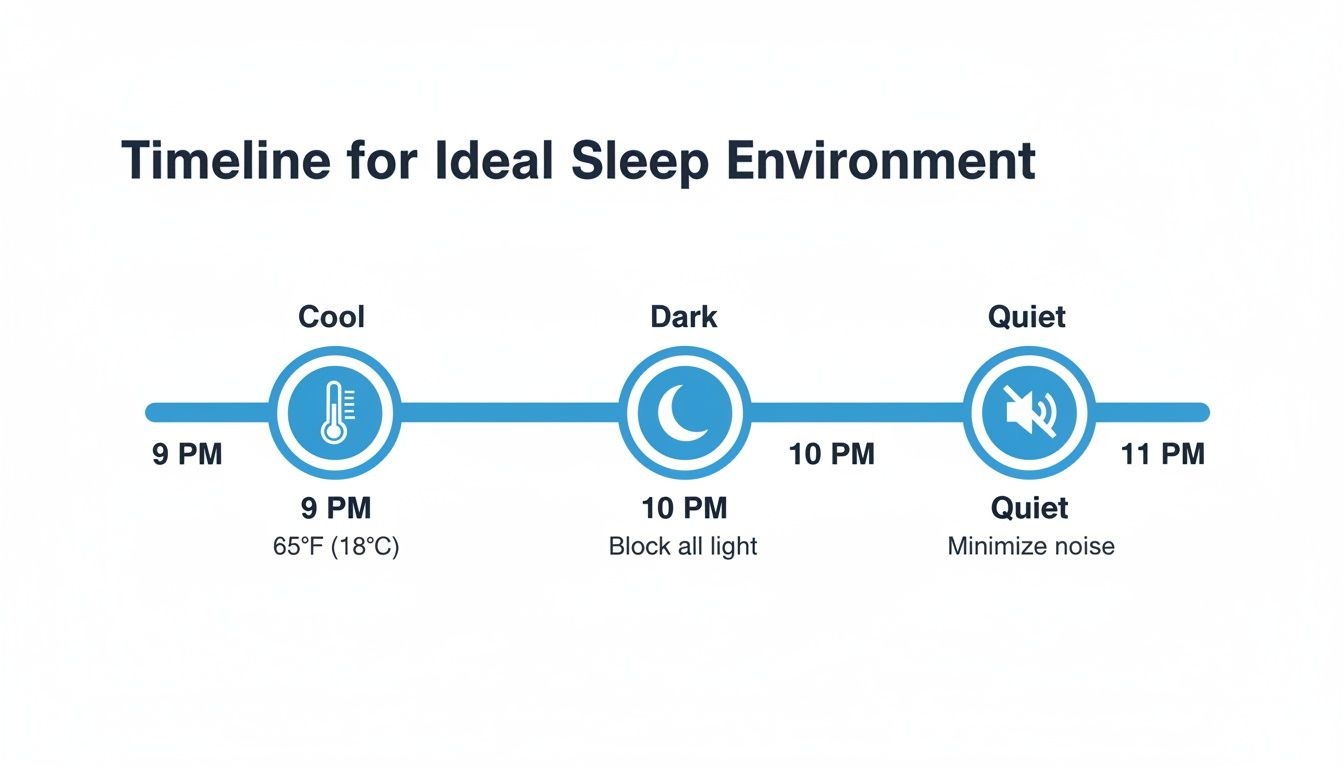
Design the Ultimate Bedroom for Deep Rest
Keep Your Bedroom Cool
The ideal temperature range for sleep is between 60-67°F (15-19°C).
Make Your Space Completely Dark
Use blackout curtains, cover LED lights, and consider a sleep mask when traveling.
Create a Quiet Haven
Use white noise machines or high-quality earplugs to mask disruptive noises.
Reinforce Your Bed as a Place for Sleep
Avoid working from bed, scrolling on your phone, or watching TV. If you're awake for more than 20 minutes, get up and do something calm in a dimly lit room until you feel sleepy again.
How Your Diet and Workouts Affect Sleep Quality
Strategic Nutrition for Better Rest
Key sleep-supporting nutrients: magnesium-rich foods, tryptophan sources, and complex carbohydrates. Cut caffeine at least eight hours before bed. Avoid large meals within three hours of bedtime.
→ Try it risk-free — 30-Day Money-Back Guarantee
Timing Your Workouts for Optimal Sleep
Regular physical activity increases time in deep sleep. For most, the sweet spot is morning or early afternoon. Avoid high-intensity training within three hours of bed.
| Activity | Optimal Timing | Reasoning |
|---|---|---|
| Last Caffeinated Drink | At least 8 hours before bed | Long half-life significantly disrupts sleep architecture if consumed too late. |
| High-Intensity Workout | Morning or early afternoon | Raises core body temperature with ample time for the body to wind down. |
| Large Evening Meal | At least 3 hours before bed | Prevents indigestion and allows the digestive system to rest during sleep. |
| Light, Low-Intensity Exercise | Finish 1-2 hours before bed | Releases tension without elevating heart rate or cortisol too much. |
| Last Alcoholic Drink | At least 3-4 hours before bed | Alcohol fragments sleep, particularly REM sleep, in the second half of the night. |
Practical Techniques to Quiet a Racing Mind

Nearly 40% of Gen Z adults report sleep-related anxiety multiple times a week.
The Power of Conscious Breathing
The 4-7-8 breathing method: Exhale completely. Inhale through nose for 4 counts. Hold for 7. Exhale through mouth for 8. Repeat three or four cycles.
The Brain Dump Journaling Technique
Spend five to ten minutes writing down everything: tomorrow's tasks, worries, and ideas. This offloads your mental chatter and gives you permission to let go for the night.
Gentle Movement to Release Physical Tension
A simple bedtime routine: neck rolls, child's pose, and cat-cow stretch.
A Smart Approach to Sleep Supplements
Key Supplements for Sleep Support
Magnesium Glycinate: Take 200-400 mg about an hour before bed. Learn more about how magnesium glycinate for sleep can be a game-changer.
L-Theanine: Promotes "wakeful relaxation" without drowsiness. Typical dose: 100-200 mg taken 30-60 minutes before sleep.
If poor sleep quality is your persistent problem despite good habits, the deeper issue may be disrupted sleep architecture — specifically a decline in slow-wave deep sleep that accelerates after 40. Our guide on how to restore your sleep cycle after 40 addresses this directly with a 4-pillar protocol and supplement strategy.
Why Form Matters: Not All Magnesium Is Equal
Magnesium oxide is poorly absorbed. Magnesium citrate may cause digestive upset. Magnesium glycinate is chelated for enhanced absorption and improved tolerance. When evaluating magnesium glycinate benefits, absorption is key.
Common Questions About Improving Sleep
How Long Until I See Real Improvements?
Most people start to feel a real difference within 1-2 weeks of consistency. For deep, lasting changes to sleep architecture, give it at least a full month.
Are Naps Actually Good for Me?
A quick power nap of 20-30 minutes in the early afternoon can boost alertness without disrupting nighttime sleep. Avoid long or late-afternoon naps.
What to Do When Waking Up at Night?
Don't lie in bed for more than 20-25 minutes. Get up, go to another dimly lit room, and do something calm and screen-free until you feel genuinely sleepy again.
Complete Your Daily Foundation
For adults over 40, the most effective daily stack combines creatine for strength and cognitive support, magnesium glycinate for recovery and sleep, and vitamin D3 for immune and bone health. Get all three together with the Essential Edge Stack — one daily habit, full foundation covered.
About the Author
Kim Brissett-Lier is the founder of Elemental Edge Health. After losing 100+ lbs in his 40s and rebuilding his strength, energy, and mental clarity through targeted supplementation and consistent daily habits, Kim created Elemental Edge to help other adults 40+ experience the same transformation — without the extremes. He writes about magnesium, creatine, Vitamin D, sleep, stress resilience, and the fundamentals of long-term health and performance.