

Amino acids are the true building blocks of muscle. Think of them as the individual bricks your body uses to build stronger, bigger muscle fibers after a tough workout. While getting enough protein is a huge piece of the puzzle, it’s the specific amino acids inside that protein—especially the nine Essential Amino Acids (EAAs)—that actually flip the switch for muscle growth.
Why Amino Acids Are the Key to Unlocking Gains

Most of us get hyper-focused on hitting our daily protein number, and for good reason. But that high-level view misses a critical detail: protein is just the delivery truck. To really get what’s happening at the muscular level, you have to look at the cargo.
Imagine you're building a house. A truck dumps a massive pile of mixed construction materials onto your site. That pile is your protein. Before you can actually build anything, you have to sort through it all to find the specific bricks, mortar, and beams you need. It's the same when you eat protein; your body has to break it down into individual amino acids before it can get to work repairing muscle.
Understanding Muscle Protein Synthesis
The entire process of building new muscle tissue is called Muscle Protein Synthesis (MPS). This is your body’s construction crew. After you lift weights, this crew takes those sorted amino acids and uses them to patch up the microscopic tears in your muscle fibers, making them bigger and stronger than before. You build muscle when the rate of this construction (MPS) is higher than the rate of muscle breakdown.
So, what tells the construction crew to clock in and start building? That signal comes from the Essential Amino Acids.
The presence of adequate EAAs in your bloodstream is the primary trigger for initiating Muscle Protein Synthesis. Without a sufficient supply of these specific building blocks, your body simply can’t repair and build new muscle effectively, no matter how hard you train.
The Role of Essential Amino Acids
Your body uses 20 different amino acids to function, but nine of them are special. They’re called "essential" because your body can't make them. You must get them from food or supplements. These nine EAAs are the non-negotiable ingredients for kickstarting muscle growth.
Here’s why they’re so important:
- They're direct activators: Certain EAAs, especially leucine, act like a key in the ignition. They directly turn on the cellular machinery responsible for MPS.
- They provide the raw materials: All nine EAAs are required to assemble new muscle protein. If you’re missing even one, the whole process grinds to a halt—like trying to build a brick wall without any mortar.
- They signal recovery: Having EAAs available tells your body it has the resources it needs to recover from a tough workout and adapt by getting stronger.
Ultimately, shifting your focus to amino acids for muscle growth changes the game. It’s no longer just about consuming protein; it’s about strategically supplying your body with the precise, high-impact materials it needs, right when it needs them most.
To see how specific formulas can support this process, you can explore our collection of amino acids.
Meet the Key Players in Muscle Building

Not all amino acids have the same job description. When you’re trying to build muscle, certain players are consistently the MVPs. Understanding their specific roles helps you move beyond just "eating protein" to strategically fueling your body for real growth and repair.
Think of it like building an all-star sports team. You need a quarterback to call the plays, powerful linemen to protect them, and a full roster of skilled athletes working together. In the world of amino acids for muscle growth, each one has a specialized job that contributes to the final win: stronger, more resilient muscle.
Leucine: The Master Switch for Growth
Leading the charge is Leucine, an amino acid with a unique and powerful responsibility. It acts as the "master switch" that directly kicks off the entire muscle-building process. Specifically, Leucine triggers a crucial cellular pathway known as mTOR, which is the primary regulator of muscle protein synthesis (MPS).
When you consume enough Leucine, it’s like flipping a switch that tells your muscle cells, "The building materials are here—start construction now!" This signal is so powerful that without adequate Leucine, MPS simply won’t reach its full potential, no matter how much other protein you eat.
Research backs up its superstar status again and again. For instance, studies show that a leucine-enriched essential amino acid (EAA) supplement can significantly boost MPS rates. A dose as small as 3 grams of Leucine has been shown to be just as effective at stimulating muscle growth in older adults as consuming 20 grams of whey protein. You can dive deeper into the science behind Leucine's impact on muscle synthesis if you're curious.
The BCAAs: A Supportive Trio
While Leucine is the star, it doesn't work alone. It's part of a famous trio known as the Branched-Chain Amino Acids (BCAAs), which also includes Isoleucine and Valine. Think of these two as Leucine's most important teammates.
-
Isoleucine: This amino acid is a key player in energy production and helps shuttle glucose into your muscle cells. During a tough workout, Isoleucine helps fuel your muscles, allowing you to train harder for longer.
-
Valine: Working alongside the other two, Valine supports muscle metabolism and helps delay the onset of fatigue. It competes with another amino acid, tryptophan, for entry into the brain, which can help reduce that feeling of tiredness during a long session.
For years, BCAAs were the go-to supplement for anyone serious about muscle growth. However, newer science has painted a more complete picture.
While BCAAs are critical, they represent only three of the nine essential amino acids required for building new muscle tissue. Giving your body only three players for a nine-person job limits the potential for muscle protein synthesis.
The Full Squad: Essential Amino Acids (EAAs)
This brings us to the Essential Amino Acids (EAAs). These nine aminos are the complete team your body needs to build muscle effectively. Taking a BCAA-only supplement is like sending out your star quarterback and two linemen—they can start a play, but they can't finish it without the rest of the team on the field.
When all nine EAAs are present, your body has the full spectrum of building blocks required to assemble new muscle protein from start to finish. This is why modern research overwhelmingly supports using a complete EAA formula over BCAAs alone for maximizing muscle growth. The presence of all essential players ensures the construction process is never halted because of a missing piece.
Other Important Contributors
Beyond the EAAs, other amino acids play valuable supporting roles. They help create an environment where your muscles can truly thrive.
-
Arginine: This amino acid is a precursor to nitric oxide, a molecule that helps relax blood vessels. This can improve blood flow to working muscles, delivering more oxygen and nutrients during exercise and helping to clear out metabolic waste products afterward.
-
Glutamine: As the most abundant amino acid in the body, Glutamine is heavily involved in recovery and immune function. Intense training can deplete Glutamine levels, so ensuring you have enough helps support your immune system and aids the overall recovery process.
To make this easier to digest, here’s a quick-reference table summarizing the key players and what they do.
Key Amino Acids and Their Roles in Muscle Growth
| Amino Acid | Primary Role | Best For |
|---|---|---|
| Leucine | Acts as the primary "on switch" for muscle protein synthesis (MPS) via the mTOR pathway. | Directly stimulating muscle growth post-workout. |
| BCAAs (Isoleucine, Valine) | Support Leucine, provide energy to muscles, and help delay workout fatigue. | Fueling performance during training and initiating the MPS signal. |
| EAAs (The Full 9) | Provide all the necessary building blocks to complete the muscle-building process. | Maximizing MPS and ensuring no "missing links" in muscle repair. |
| Arginine | Increases nitric oxide production, improving blood flow and nutrient delivery. | Enhancing workout "pumps" and supporting nutrient transport. |
| Glutamine | Supports immune function and aids in post-workout recovery. | Aiding overall recovery, especially during intense training blocks. |
By understanding who these key players are and their specific jobs, you can make smarter decisions about your nutrition and supplementation. This way, you can ensure your body has every tool it needs to build the strength and muscle you’re working so hard for.
Strategic Timing and Dosing for Maximum Gains
Knowing which amino acids build muscle is step one. The real magic, though, happens when you figure out when and how much to take. This is where we go from theory to an actual plan that makes every single rep count. It’s not about just chugging a supplement; it's about giving your body the right materials at exactly the right time.
For a long time, everyone was obsessed with the "anabolic window"—that mythical 30-minute slot after a workout where you had to slam a protein shake or your gains would supposedly vanish. There’s a sliver of truth there. Your muscles are primed for nutrients after you train. But we now know that window is much, much wider than we thought.
Modern science shows us that what really matters is keeping a steady supply of amino acids available all day long. Think of it less like a frantic sprint to the shaker cup and more like a constant, slow drip of resources for a 24/7 construction project. This consistency keeps your body in a muscle-building state and prevents it from slipping into breakdown mode.
How Much Amino Acids Do You Need?
When it comes to dosing amino acids for muscle growth, precision beats sheer volume. The goal isn’t to flood your system. It’s to provide just enough to kick off a powerful anabolic response without any waste.
For a complete Essential Amino Acid (EAA) supplement, the research points to a sweet spot of 10–15 grams per serving. This dose delivers a solid supply of all nine essential building blocks your body can't make on its own, setting the stage for effective repair and growth.
But inside that dose, one amino acid is the undisputed king: Leucine.
To effectively "flip the switch" for Muscle Protein Synthesis (MPS), you need at least 3 grams of Leucine in your serving. This is the scientifically recognized trigger point needed to activate the mTOR pathway, which is the master regulator that signals your muscles to grow.
Think of Leucine as the foreman on a construction site. You can have all the bricks and mortar (the other EAAs) piled up and ready to go, but nothing happens until the foreman gives the green light. Hitting that 3-gram Leucine threshold ensures the signal is sent loud and clear. Any less, and the muscle-building response will be weak, no matter how many other aminos you’re taking.
Building Your Amino Acid Schedule
Weaving amino acids into your daily routine is actually pretty simple. By timing your intake around your workouts, you can protect your hard-earned muscle, keep your energy up, and kickstart recovery.
Here’s a simple and effective protocol:
1. Pre-Workout Protection
Taking 10–15 grams of EAAs about 30 minutes before you train gets your body ready for action. It pre-loads your bloodstream with amino acids, creating a shield that helps prevent your body from breaking down muscle tissue for fuel during a tough workout.
2. Intra-Workout Sustenance
If you're in for a long, grueling session (anything over 60–90 minutes), sipping on an EAA drink can be a total game-changer. This provides a steady trickle of fuel straight to your muscles, helping you push back fatigue and stay in a muscle-building state even while you’re still training.
3. Post-Workout Recovery
Taking another 10–15 gram serving of EAAs within an hour or two after your workout is key. Because these are free-form amino acids, they’re absorbed way faster than whole protein from food. They get to your muscle cells almost immediately to start the repair process. To really dig into optimizing this phase, check out our guide on how to speed up muscle recovery with other smart strategies.
This simple, structured approach ensures your muscles have everything they need, right when they need it most—before, during, and after you train. It’s a small tweak that can shift your body from just repairing damage to actively building and adapting, making sure every workout moves you closer to your goals.
Choosing Between Whole Foods and Supplements
A well-stocked kitchen is the bedrock of any solid muscle-building plan. Getting the lion's share of your nutrients from high-quality, whole foods isn't just a suggestion—it's non-negotiable. But when it comes to maximizing amino acids for muscle growth, the debate isn't about food versus supplements. It's about using the right tool for the job.
Think of it like this: your daily diet is your primary construction crew, working steadily all day to build and maintain your body. But in the moments right after a workout, your muscles are in an emergency repair state. You don't need the whole crew; you need a specialized, fast-acting team to get on-site immediately. That's precisely where supplements come into play.
The Power of a Food-First Approach
Whole protein sources like chicken, beef, eggs, and dairy are fantastic. They’re packed with the complete spectrum of Essential Amino Acids (EAAs) your body needs to grow.
They also deliver a host of other vital nutrients—vitamins, minerals, and healthy fats—that support overall health and recovery. That chicken breast isn't just giving you protein; it's also delivering B vitamins essential for energy metabolism.
This nutrient density is exactly why food must always be your foundation. The catch? The body has to digest these complex proteins first, a process that can take hours. While that slow, steady release is perfect for maintaining a positive amino acid balance throughout the day, it's not ideal when you need to kickstart recovery right now.
Key Takeaway: Rely on whole foods for your baseline nutritional needs and sustained amino acid delivery. Supplements are a strategic tool, not a replacement for a solid diet.
The infographic below really nails the ideal timing for using a fast-acting supplement to get the most out of your training.
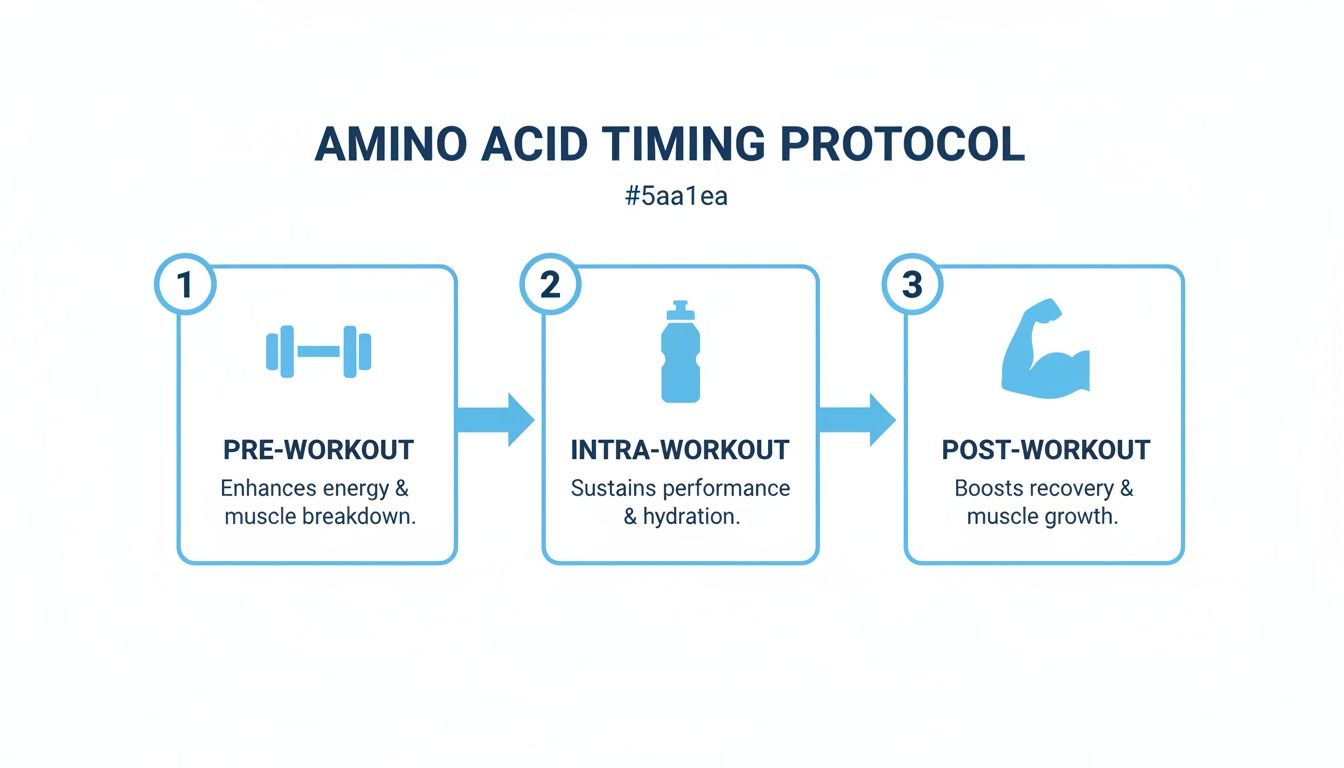
As you can see, strategic supplementation before, during, and after your workout can protect muscle from breakdown and seriously accelerate recovery.
The Strategic Edge of Amino Acid Supplements
This is where free-form amino acid supplements really shine. Unlike the aminos all bound together in a steak or a protein shake, these are already broken down into their simplest form. They require virtually no digestion and get absorbed directly into your bloodstream within minutes.
This rapid-fire absorption gives you two huge advantages:
- Speed: They can reach your muscles almost instantly, delivering the raw materials for repair precisely when your body is most receptive—right around your workout.
- Precision: Supplements allow you to flood your system with a specific, targeted dose of the most important muscle-building aminos, like leucine, to guarantee you’re flipping the switch on Muscle Protein Synthesis.
Whole Foods vs. EAA Supplements Comparison
Deciding when to eat and when to supplement can feel tricky, but it's really about timing and goals. The table below breaks down the key differences to help you build the perfect strategy.
| Attribute | Whole Protein Foods (e.g., Chicken, Whey) | Free-Form EAA Supplements |
|---|---|---|
| Digestion Speed | Slower (1-3+ hours) | Extremely fast (15-30 minutes) |
| Nutrient Profile | Complete protein + vitamins, minerals, fats | Isolated, targeted amino acids |
| Primary Benefit | Sustained amino acid release, overall nutrition | Rapid MPS activation, immediate recovery fuel |
| Best Use-Case | Main meals, daily protein intake | Pre-, intra-, and post-workout window |
| Convenience | Requires preparation and cooking | Mixes instantly with water |
In short, you need both. Use whole foods to build your nutritional foundation and supplements to capitalize on the critical workout window.
Whey Protein: The Best of Both Worlds?
So, where does a classic whey protein shake fit into all this? Whey is a unique hybrid. It's technically a whole food source derived from dairy, but it digests much, much faster than a solid meal like chicken or beef. This makes it an excellent post-workout choice.
However, even whey takes time to be broken down into individual amino acids. A free-form EAA supplement remains the absolute fastest delivery system available. For a deeper dive into whey's unique properties, you might want to check out our complete guide to whey protein.
The smartest strategy uses both. Build your diet around high-quality protein from whole foods to cover your daily needs. Then, use a fast-acting EAA supplement around your training sessions to provide that immediate, targeted support that food just can't match. This complementary approach ensures your body has everything it needs for both sustained growth and rapid recovery.
Tailoring Amino Acids to Your Age and Goals
An effective amino acid strategy is never one-size-fits-all. Your goals, how long you've been training, and even your age all play a huge role in what works best. Think of it less like a rigid prescription and more like fine-tuning an instrument—the fundamentals are the same, but the application gets more precise as your needs change.
Customizing your approach ensures you’re giving your body exactly what it needs to adapt and get stronger, whether you're brand new to the gym or a seasoned athlete.
For the Beginner: A Simple and Effective Start
If you're new to resistance training, your body is incredibly responsive to this new stress. You don't need a complex supplement stack to make great progress; in fact, simplicity is your best friend right now. Your main job is to show up consistently and master the fundamentals.
A simple, effective plan is to use a complete Essential Amino Acid (EAA) supplement around your workouts. Taking one serving of 10-15 grams of EAAs, with at least 3 grams of Leucine, about 30 minutes before or right after you train is a perfect starting point. This helps kickstart recovery, reduce muscle breakdown, and leaves you feeling less sore and ready for your next session.
For the Advanced Athlete: Stacking for Peak Performance
Once you're an experienced lifter, the game changes. Progress comes in smaller increments, and you're operating on much thinner margins. This is where strategically "stacking"—or combining supplements that work together—can give you a real, measurable edge.
One of the most effective and well-researched stacks is combining EAAs with creatine monohydrate. They form a powerful duo for a simple reason:
- EAAs: They provide the raw building blocks to repair muscle and directly flip the switch on Muscle Protein Synthesis (MPS).
- Creatine: It fuels your performance in the gym by helping you produce more energy (ATP) for short, explosive efforts. This means more strength and more reps.
By taking EAAs to maximize the repair process and creatine to maximize your work output, you create a powerful one-two punch for muscle growth. You’re simultaneously pushing your performance ceiling higher and enhancing your body’s ability to recover from that new, higher workload.
For Older Adults: Combating Age-Related Muscle Loss
Amino acids become an especially powerful tool for older adults looking to maintain strength, mobility, and independence. As we age, our muscles can become less sensitive to the growth signals from protein—a phenomenon known as anabolic resistance. This can lead to sarcopenia, the gradual loss of precious muscle mass.
The good news is that the rapid absorption and high Leucine content of EAA supplements can effectively bypass this resistance. They deliver a potent, direct signal to your muscles that is far more efficient than slower-digesting whole proteins.
The impact is remarkable. Research shows that even a tiny dose of 3.6 grams of an EAA formula can significantly boost muscle protein synthesis in older adults. This small amount increases the fractional synthesis rate by 0.058% per hour over three hours, with roughly 80% of the ingested EAAs going directly toward building new muscle. This is huge, especially considering our muscles are made of about 40% EAAs. It shows just how effectively a small, targeted dose can counter age-related muscle loss. You can explore the full study on EAA efficiency in older adults to learn more.
By adapting your amino acid strategy to where you are in your fitness journey, you ensure you're not just taking a supplement, but actively supporting your body's unique needs for growth and maintenance.
Common Questions About Amino Acids
Even after getting the science down, it’s totally normal to have a few questions. The world of supplements can feel complicated, and getting clear, straightforward answers is the best way to build a routine that actually works.
We’ll tackle the most common questions we hear, cutting through the noise to give you direct answers. Think of this as your quick-reference guide to using amino acids for muscle growth with complete confidence.
Are BCAA Supplements Still Worth Taking?
This question comes up all the time, and for good reason—BCAAs were the king of muscle supplements for years. While they aren't harmful, we now know they don’t tell the whole story. The BCAAs (Leucine, Isoleucine, and Valine) are just three of the nine essential amino acids your body needs to actually build new muscle tissue.
Imagine trying to build a complex Lego model but you only have three types of bricks. You can get started, but you'll hit a wall pretty fast because you're missing all the other essential pieces. That's exactly what happens with a BCAA-only supplement.
While BCAAs can help reduce muscle soreness and fatigue during a workout, they are inefficient for stimulating actual muscle growth on their own. For robust muscle protein synthesis, you need the full team of all nine Essential Amino Acids (EAAs).
EAAs provide every single "brick" your body needs, ensuring the muscle-building process can run from start to finish without any missing links. So, while BCAAs have a couple of perks, a complete EAA supplement is a far better choice for anyone serious about gaining muscle.
Should I Take Amino Acids on Rest Days?
Yes, absolutely. This is a critical point that trips a lot of people up. Your muscles don't just grow while you're lifting in the gym; the real magic happens during the hours and days that follow. Recovery is a 24/7 job for your body.
Taking an EAA supplement on your rest days helps keep your body in a positive net protein balance. This simply means you're supplying your body with more building blocks than it's breaking down, creating the ideal anabolic environment for repair and growth to continue uninterrupted.
Think of it like this: you're keeping the construction crew supplied with materials even on their "off" days. This steady stream of amino acids ensures the rebuilding process never has to pause, helping you recover faster and show up to your next workout stronger. A single serving of 10-15 grams of EAAs on a rest day is a fantastic strategy.
Are There Any Side Effects to Amino Acid Supplements?
For the vast majority of healthy people, amino acid supplements are incredibly safe when taken as directed. After all, amino acids are just the pre-digested components of protein—something your body already knows exactly what to do with.
The most common issue, though rare, is minor digestive upset like bloating or an upset stomach. This usually only happens when someone takes a dose that's way higher than recommended. Sticking to the scientifically supported range of 10-20 grams per serving almost always prevents any issues.
To be sure you're getting a safe and effective product, always choose a high-quality supplement from a brand you trust. Look for products that are:
- Third-party tested for purity and potency.
- Free from unnecessary fillers, artificial colors, or shady proprietary blends.
- Clearly dosed so you know exactly what you’re getting.
By choosing a clean, transparent product, you can confidently support your goals without worrying about unwanted side effects.
What Is the Difference Between Amino Acids and a Protein Shake?
This is a great question that really gets to the heart of smart nutrient timing. Both amino acid supplements and protein shakes are valuable, but they serve different purposes based on how fast they're digested.
Think of a protein shake (like whey or casein) as a whole log of wood. Your body has to spend time sawing, chopping, and processing that log to get to the individual planks—the amino acids. This process provides a slower, more sustained release of building blocks into your bloodstream.
An EAA supplement, on the other hand, is like getting the planks delivered directly to your job site. The "chopping" has already been done for you. These free-form amino acids require almost no digestion and are absorbed into your system within minutes.
Here’s a simple breakdown of when to use each:
- Protein Shakes: Perfect for meeting your overall daily protein targets, as a meal replacement, or when you need a slower, sustained release of aminos (like before bed).
- EAA Supplements: Ideal for the window around your workout (pre, intra, or post) when you need to flood your muscles with building blocks as quickly as possible to stop muscle breakdown and kickstart recovery.
Both have a place in a smart nutrition plan. Use protein shakes for your daily foundation and EAAs for fast-acting, targeted support when it matters most.
Ready to fuel your muscles with clean, effective, and research-backed formulas? The Elemental Edge Health collection is crafted with non-GMO, filler-free ingredients to help you achieve peak performance and recovery. Explore our premium supplements and build your perfect wellness routine today at https://www.elementaledgehealth.com.