

Building muscle faster isn't about some secret workout or miracle supplement. It's a science, plain and simple, and it all boils down to three core principles: strategic training, precision nutrition, and optimized recovery.
When you master how these pillars work together, you unlock accelerated gains that you'll never achieve by focusing on just one piece of the puzzle.
The Blueprint for Rapid Muscle Growth
So, you want to build muscle faster? The good news is the process is straightforward, but it demands consistency. It’s less about finding a single magic bullet and more about creating a powerful system where your training, diet, and recovery all sync up to drive hypertrophy—the scientific term for muscle growth.
Think of it like building a house. Your workouts are the labor, tearing down old structures to make way for something bigger and better. Nutrition provides the high-quality bricks and mortar needed to build back stronger. And recovery? That's when all the real construction happens, solidifying your progress while you rest. Neglect any one of these, and the whole project grinds to a halt.
This cycle—Train, Fuel, Recover—is a continuous loop.
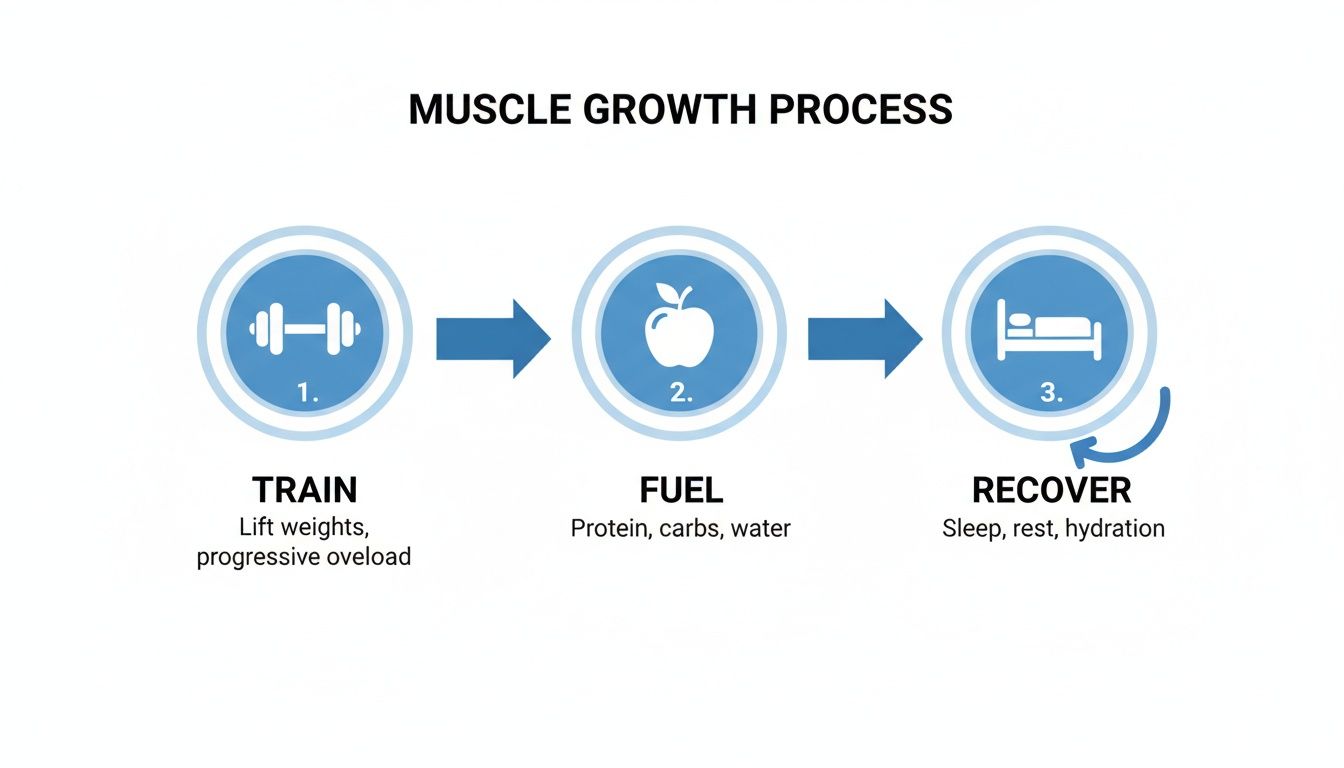
As the diagram shows, progress isn't made in the gym alone. It's the result of this complete, unbroken cycle that turns your hard work into real, measurable results.
The Four Pillars of Faster Muscle Growth
To get more specific, we can break this blueprint down into four actionable pillars. Each one plays a distinct role, and understanding how they interact is the first step toward accelerating your results. This framework is our guide, ensuring every piece of advice ties back to these fundamentals.
The most effective muscle-building programs are built on a foundation of consistency, not just intensity. A good plan followed consistently will always outperform a perfect plan followed sporadically.
To put it all together, here’s a quick summary of the essential components required to speed up muscle growth and what each one is responsible for.
Four Pillars of Faster Muscle Growth
| Pillar | Primary Role | Key Action |
|---|---|---|
| Progressive Overload | Create the stimulus for muscle growth by consistently challenging your muscles. | Systematically increase weight, reps, or sets over time. |
| Caloric Surplus | Provide the energy your body needs to build new muscle tissue. | Consume slightly more calories than your body burns daily. |
| Adequate Protein | Supply the building blocks (amino acids) for muscle repair and synthesis. | Eat 1.6–2.2 grams of protein per kilogram of body weight. |
| Sufficient Recovery | Allow muscle tissue to repair and grow stronger after training. | Prioritize 7-9 hours of quality sleep and manage stress. |
Think of this table as your cheat sheet. As long as you're hitting all four of these targets, you're on the fast track to building serious muscle.
Mastering Progressive Overload for Consistent Gains
If there's one unbreakable law for building muscle, it’s progressive overload. This principle is the engine driving every ounce of progress you make in the gym. Put simply, to grow, you have to consistently ask your muscles to do more than they’re used to. Without that increasing demand, your body has no reason to adapt.
Most people hear "progressive overload" and immediately think of piling more weight on the bar. While adding load is a fantastic way to progress, it's just one tool in your toolbox. Relying on that alone is a fast track to plateaus, bad form, and injury. True mastery is about understanding all the ways you can challenge your body.
This core principle is precisely why the global weight training market, currently valued at $12.1 billion, is expected to climb to $16.26 billion by 2035. People are getting results. With 36.5% of gym members focused on building muscle, the science is clear: applying progressive overload 3-5 times a week is what triggers hypertrophy. Explore more data on the growing weight training market to see just how foundational this strategy has become.
Smart Ways to Apply Progressive Overload
To keep the gains coming and avoid getting stuck, you need to think beyond just the weight on the bar. You can tweak several variables to create the stimulus your muscles need. Here are the most effective methods to work into your training.
- Increase Repetitions: Before you even touch a heavier weight, can you squeeze out another rep or two with perfect form? Taking your bench press from 8 reps to 10 reps with 185 pounds is undeniable progress.
- Increase Sets: Adding another quality set to your main lifts is a powerful way to crank up your total workout volume, a primary driver of muscle growth. If you normally do 3 sets of squats, try pushing for a fourth next week.
- Decrease Rest Times: Trimming the rest period between your sets makes your workout denser and ramps up metabolic stress. If you usually rest for 90 seconds, try cutting it to 75. Your muscles will be forced to work harder with less recovery.
- Improve Execution: This is the most underrated form of progression. Consciously slowing down the negative (the lowering phase) of a lift or pausing at the bottom of a squat dramatically increases time under tension, creating a potent growth stimulus.
The goal isn't just to move weight; it's to make the weight you're moving feel harder in a controlled, intentional way. The quality of the stimulus will always beat the quantity of sloppy reps.
A Real-World Example of Progression
Let’s put this into practice. Say your goal is to improve your dumbbell shoulder press, and you’re currently using 50-pound dumbbells for 3 sets of 8 reps. If you stick with that for months, you’ll get nowhere.
Here’s a sample 12-week progression that cycles through different overload methods:
Weeks 1-4: Focus on Reps
- Goal: Work your way from 8 reps up to 12 with the same 50 lb dumbbells.
- Week 1: 3 sets of 8 reps.
- Week 2: Aim for 3 sets of 9 reps.
- Week 3: Push for 3 sets of 10-11 reps.
- Week 4: Lock in 3 sets of 12 clean reps.
Weeks 5-8: Focus on Load
- Goal: You’ve earned the right to go heavier.
- Week 5: Grab the 55 lb dumbbells and drop back down to 3 sets of 8 reps.
- Week 6-8: Now, repeat the process. Systematically work your way back up toward 12 reps with the new, heavier weight.
Weeks 9-12: Focus on Volume and Density
- Goal: Increase the total amount of work you’re doing.
- Week 9: Add a fourth set. Perform 4 sets of 8 reps with the 55 lb dumbbells.
- Week 10: Keep the 4 sets but shorten your rest time from 90 seconds to 75.
- Week 11: Stick with the shorter rest and push for 9-10 reps per set.
- Week 12: Consolidate your strength.
This structured plan ensures you’re always giving your body a new problem to solve. By tracking your workouts meticulously in a logbook or app, you turn every session from a guess into a calculated step forward, guaranteeing you build muscle faster.
Fueling Your Muscles with Precision Nutrition
You can’t build a house without bricks, and you simply can't build muscle without the right fuel. Your training sessions are the stimulus, but nutrition is what provides the raw materials to actually make growth happen. An intelligent eating plan is what separates slow, frustrating progress from rapid, noticeable gains.
It all starts with energy. To construct new muscle tissue, your body needs a surplus of calories—more energy coming in than you burn each day. A common mistake here is blasting past this target, which only leads to unwanted fat gain that hides your hard-earned muscle.

The key is a controlled, modest surplus. Adding just 250-500 calories above your daily maintenance level is the sweet spot. This gives your body enough extra energy for muscle repair and growth without overwhelming its ability to use those nutrients effectively.
Calculating Your Caloric Surplus
First, you need a baseline. You can use an online TDEE (Total Daily Energy Expenditure) calculator to get a solid estimate of your maintenance calories. This number accounts for your age, weight, height, and activity level.
Once you have that maintenance number, just add your surplus.
- For leaner gains: Start with a +300 calorie surplus.
- For faster gains (with a bit more potential fat): Aim for a +500 calorie surplus.
Keep an eye on the scale and the mirror each week. If you're not gaining about 0.5 pounds per week, you can bump up your intake slightly. If you're gaining much faster, you’re likely adding more fat than muscle and should dial it back.
A smart caloric surplus is the foundation of your muscle-building diet. It’s the difference between spinning your wheels and giving your body the essential energy it needs to construct new, stronger muscle fibers.
Protein: The Master Building Block
Calories provide the energy, but protein provides the actual building blocks. The amino acids from protein are what your body uses to repair the microscopic muscle tears from training, rebuilding them bigger and stronger. Without enough protein, that process stalls, no matter how hard you train.
For optimal muscle growth, the scientific consensus points to a daily intake of 1.6 to 2.2 grams of protein per kilogram of body weight (that’s about 0.7 to 1.0 grams per pound). So, if you weigh 180 pounds (82 kg), you should be eating between 131 and 180 grams of protein every single day.
Spreading this intake out is also critical. Aiming for 20-40 grams of protein every 3-4 hours helps keep muscle protein synthesis (MPS) elevated, creating a constant environment for growth.
The Supporting Roles of Carbs and Fats
While protein gets all the attention, carbohydrates and fats are absolutely essential for maximizing your potential. Think of them as the critical support crew for energy and hormones.
- Carbohydrates: These are your body's number one fuel source for tough workouts. Getting enough carbs replenishes your muscle glycogen stores, giving you the energy to push harder and achieve the progressive overload needed for growth. Skimp on carbs, and your performance will tank.
- Fats: Dietary fats are vital for producing key muscle-building hormones, including testosterone. Healthy fats from sources like avocados, nuts, seeds, and olive oil also help reduce inflammation and keep your joints healthy.
A balanced approach that prioritizes all three macronutrients is the only way to ensure your body has everything it needs to perform, recover, and grow.
Sample Daily Macronutrient Targets for Muscle Growth
To help you visualize this, here’s a breakdown of what the macronutrient goals might look like for a 180 lb (82 kg) person aiming for lean muscle gain on a 2,800-calorie diet.
| Macronutrient | Grams per Day | Calories | Primary Role |
|---|---|---|---|
| Protein | 165g | 660 | Muscle repair and growth |
| Carbohydrates | 350g | 1,400 | Fuel for training and glycogen replenishment |
| Fats | 82g | 740 | Hormone production and overall health |
This table shows how a balanced intake supports your goals from every angle—providing the building blocks, the fuel for performance, and the support for your hormonal system.
Hitting these numbers can feel like a lot at first, but a little planning makes it simple. Here’s a sample day designed for that same 180-pound person targeting around 165g of protein with a slight caloric surplus.
- Meal 1: Scrambled Eggs (4 whole) with Spinach, Oatmeal with Berries (35g protein)
- Meal 2: Greek Yogurt (1 cup) with a Handful of Almonds (25g protein)
- Meal 3: Grilled Chicken Breast (6 oz), Quinoa, and Broccoli (45g protein)
- Meal 4: Whey Protein Shake with Milk and a Banana (30g protein)
- Meal 5: Salmon (5 oz) with Sweet Potato and Asparagus (30g protein)
This structure provides a steady stream of protein and energy, keeping your body primed for growth all day long. A high-quality whey protein shake, like in Meal 4, is an incredibly efficient way to hit your protein target without feeling overly full. If you're new to this kind of supplement, you can learn more in our detailed guide to using whey protein effectively.
With a bit of planning, precision nutrition quickly becomes second nature.
Optimize Recovery With Sleep and Stress Management
The hard work you put in at the gym is only half the story. Training is where you break down muscle fibers and create the potential for growth. The actual repair and rebuilding? That all happens when you’re resting.
This is why you have to treat recovery as an active, non-negotiable part of your training. It’s the secret to building muscle faster. Two of the most powerful—and often overlooked—drivers of recovery are sleep and stress management.

Without quality rest, you’re leaving gains on the table. Your body needs that downtime to mend the damage from your workouts. If it doesn't get it, your progress will stall. Think of your gym sessions as flipping the switch, but sleep is when the real magic of muscle growth kicks in.
The Anabolic Power of Sleep
Sleep isn't just downtime; it's when your body's repair and growth hormones hit their peak. During the deep stages of sleep, your pituitary gland releases a huge surge of Human Growth Hormone (HGH). This hormone is absolutely critical for repairing tissues, including the muscles you just trained.
At the same time, cortisol—a stress hormone that can be catabolic (muscle-wasting)—naturally drops during sleep. This hormonal shift creates the perfect anabolic environment for muscle protein synthesis, turning the protein you ate during the day into new muscle.
Aiming for 7-9 hours of quality sleep per night isn't just a suggestion; it's a requirement if you want to maximize this process.
"Sleep is the most effective performance-enhancing activity you can do. It's during sleep that your body releases the hormones that facilitate muscle repair and growth, making it just as important as your last set in the gym."
Improving your sleep quality doesn't have to be complicated. A few simple strategies can make a massive difference in how well you recover.
- Create a Wind-Down Routine: An hour before bed, ditch the bright screens. The blue light messes with your natural melatonin production. Try reading a book, doing some light stretching, or listening to calm music instead.
- Optimize Your Bedroom: Make your room cool, dark, and quiet. Blackout curtains and a white noise machine can work wonders.
- Be Consistent: Try to go to bed and wake up around the same time every day, even on weekends. This helps regulate your body's internal clock for more predictable, restful sleep.
If you're looking for more ways to enhance your post-workout healing, our guide offers additional strategies on how to speed up muscle recovery for better results.
How Chronic Stress Sabotages Your Gains
Just as deep sleep creates a muscle-building environment, chronic stress does the exact opposite. When you're constantly stressed from work, life, or even overtraining, your body pumps out high levels of cortisol. While a little cortisol is fine, chronically elevated levels will wreck your physique.
Elevated cortisol directly interferes with muscle growth by inhibiting protein synthesis, encouraging the breakdown of existing muscle for energy, and promoting fat storage around your midsection. In short, high stress puts your body into a catabolic state, actively working against all your hard work.
This is why a holistic approach to fitness is so important. The global fitness club market, which hit $121.19 billion, is projected to reach $244.70 billion by 2032, largely because people are finally integrating total wellness into their routines.
Corporate wellness programs, for example, are helping professionals manage stress, which can improve sleep quality by 25% and directly boost HGH. Combining smart training with recovery techniques can even cut post-workout inflammation by 30%, letting you train harder, more often.
Here are a few simple ways to get your stress under control:
- Mindful Breathing: Take 5 minutes to practice deep belly breathing. Inhale through your nose for a four-count, hold for four, and exhale slowly through your mouth for six. It works.
- Get Outside: A short walk, especially in nature, can significantly lower cortisol levels and clear your head.
- Manage Your Time: Feeling overwhelmed is a huge stressor. Use a planner or a digital tool to organize your day and get a sense of control.
Using Supplements to Gain a Competitive Edge
Once your training, nutrition, and recovery are dialed in, smart supplementation can give you a real edge. Think of supplements not as a substitute for hard work and good food, but as a way to fine-tune your body’s muscle-building machinery. The market is flooded with hype, so it’s crucial to focus only on what’s actually proven to work.

This isn’t about chasing miracle pills. It's about using science-backed compounds to get a measurable boost in strength, endurance, and recovery. By sticking to the essentials, you put your money where it counts and avoid wasting it on products that don't deliver.
The Proven Performers You Need to Know
When it comes to building muscle, a few supplements consistently rise to the top in scientific research. These are the workhorses that have been tested time and again. Let's cut through the noise and focus on the "big three" that can truly move the needle.
- Creatine Monohydrate: This is arguably the most researched and effective supplement for boosting strength and power. Creatine works by increasing your muscle cells' immediate energy reserves, letting you push harder for longer.
- Protein Powders: While not magical, protein powders (like whey, casein, or plant-based blends) are just an incredibly convenient way to make sure you hit your daily protein goals for muscle repair.
- Beta-Alanine: Known for the tingly feeling it can cause, beta-alanine helps buffer acid in your muscles during intense sets. This improves your muscular endurance, allowing you to squeeze out those extra growth-stimulating reps.
Focus on mastering the basics before you even think about supplements. A scoop of creatine won't make up for a poor diet or inconsistent training. But once your foundation is solid, it can definitely amplify your results.
How to Use the Big Three for Maximum Impact
Knowing what to take is only half the battle. Knowing how and when is what unlocks their full potential. Here are the simple, evidence-based protocols for these core supplements.
Creatine Monohydrate
This supplement works by saturating your muscles, so consistency is everything. You don't need to overcomplicate it with loading phases or specific timing.
- Dosage: Just take 3-5 grams of creatine monohydrate daily.
- Timing: Any time of day that works for you. Mix it in water, juice, or your protein shake. Just get it in every day.
If you want to go deeper, our article explaining what creatine is and how it works has all the details.
Protein Powder
A protein supplement is a tool to help you reach your daily protein target, which should be around 1.6-2.2 grams per kilogram of body weight.
- Dosage: A serving of 20-40 grams post-workout is perfect for kick-starting muscle protein synthesis.
- Timing: The old-school "anabolic window" isn't as critical as we once thought, but having a shake within an hour or two of your workout is still a great strategy. It's also useful between meals to keep your protein intake high.
Beta-Alanine
Like creatine, beta-alanine needs to build up in your system over time to be effective.
- Dosage: Aim for 3-6 grams per day. To minimize the harmless tingling sensation (paresthesia), you can split this into a few smaller doses.
- Timing: The exact timing isn't critical, but many people like to include it in their pre-workout routine.
Supporting Supplements for Overall Health
Beyond the big three, a couple of other supplements can support the systems that indirectly contribute to muscle growth, mainly by improving your overall health.
- Vitamin D: This vitamin is critical for hormonal health (including testosterone) and immune function. If you don't get much sun, a supplement is a smart move.
- Omega-3 Fatty Acids: Found in fish oil, these healthy fats help manage inflammation, which can mean better recovery between your workouts.
The supplement industry is massive for a reason—these products work when used correctly. The global muscle building supplements market was valued at $25.1 billion and is projected to hit $40.5 billion by 2032. This growth is driven by people seeking proven results, with data showing that combining resistance training with supplements like protein can boost muscle protein synthesis by up to 30%. You can discover more insights about the muscle supplement market on 24marketreports.com to see how these products are fueling performance.
By focusing on this short list of proven ingredients, you can confidently invest in your progress and build muscle faster.
Common Questions About Building Muscle Faster
Navigating the world of fitness often means sorting through a sea of conflicting advice. When your goal is to build muscle faster, getting clear, science-backed answers to the most common questions can save you a ton of time and frustration. Let's tackle some of the big ones.
This isn't about fluff—it's about giving you actionable answers to refine your strategy. Understanding the details behind muscle gain, training intensity, and body recomposition will help you move forward with more confidence and precision.
How Much Muscle Can I Realistically Gain in a Month?
This is the big one, the question everyone wants an answer to. For a beginner putting in the work, a realistic rate of gain is about 1-2 pounds of lean muscle per month. Progress is always fastest when you first start lifting because your body is so incredibly responsive to the new training stimulus.
But that initial surge doesn't last forever, and that's completely normal.
- Intermediate Lifters: After 1-3 years of consistent training, that number drops to around 0.5-1 pound per month.
- Advanced Lifters: For veterans who have been dedicated for years, gaining even a few pounds of lean muscle over an entire year is a huge win.
These numbers are heavily influenced by genetics, how smart your training is, how dialed-in your nutrition is, and your recovery quality. Trying to rush the process beyond these rates usually just leads to packing on fat, not more muscle. Patience is the name of the game here.
The fastest progress you'll ever make is in your first year. Embrace it, stay consistent, and don't get discouraged when the rate of gain inevitably slows down. It's a sign you're no longer a beginner, not a sign you've hit a wall.
Do I Need to Train to Failure on Every Set?
The short answer? Absolutely not. In fact, doing so can actually work against you. While taking a set to muscular failure—that point where you physically can't squeeze out another rep with good form—is a powerful tool for growth, it shouldn't be used on every set of every workout.
Training to failure is incredibly taxing on your central nervous system. Do it too often, and you're just asking for overtraining, systemic fatigue, and a much higher risk of injury. You'll find it harder to recover between workouts, which ultimately stalls your progress.
A smarter, more sustainable approach is to train close to failure. For the majority of your working sets, aim to leave 1-2 Reps in Reserve (RIR). This just means you end the set feeling like you could have done one or two more clean reps if your life depended on it. This gives your muscles more than enough of a signal to grow while allowing for better recovery and consistent, long-term gains.
Is It Possible to Build Muscle and Lose Fat at the Same Time?
Yes, it’s definitely possible. This process is called body recomposition, but how well it works really depends on your training experience and current body composition.
"Recomping" is most effective for two main groups:
- Beginners: Their bodies are primed for change and can readily pull from stored body fat to get the energy needed to build new muscle tissue.
- Individuals returning from a break: Anyone who was previously fit but took a long layoff can regain muscle quickly (thanks to muscle memory) while shedding the fat they may have gained.
For experienced, lean lifters, it's a much tougher and slower game. The biological signals to build muscle (a calorie surplus) and lose fat (a calorie deficit) are fundamentally at odds. It requires a meticulous nutritional plan—often a tiny deficit or eating at maintenance with extremely high protein—paired with intense, consistent resistance training.
At Elemental Edge Health, we believe that achieving your peak physical potential starts with a solid foundation of clean, effective nutrition. Our range of non-GMO protein powders, creatine, and recovery supplements is designed to support your muscle-building journey every step of the way. Fuel your gains with research-backed formulas you can trust by visiting https://www.elementaledgehealth.com.